Amazon and Shopify Fulfillment: How to Sync Inventory and Master Multichannel Logistics
Selling on both Amazon and Shopify is no longer a growth strategy reserved for large brands - it is the default for any seller serious about scale. But running two channels means running two fulfillment workflows, two inventory pools, and two sets of fees that get restructured almost every January: Amazon held US referral and FBA fees flat in 2025, then raised FBA fees again effective January 15, 2026. In 2026, multichannel inventory management is not just an operational challenge. It is a financial one, and getting it wrong can cost you five figures in a single quarter.
This guide explains how to connect Amazon and Shopify fulfillment into a single synchronized system, when to use Amazon's Multi-Channel Fulfillment (MCF), when a dedicated 3PL is the better move, and how to build a hybrid model that maximizes both speed and margin.
The 2026 Fee Landscape: What Changed
Amazon raised Multi-Channel Fulfillment fees by an average of $0.30 per unit as of January 15, 2026, with the largest increases hitting single and two-unit orders. FBA fees rose by an average of $0.08 per unit sold overall, and for standard size the increase depends on the price tier: below $10, small standard went up $0.12 and large standard did not change; from $10 to $50, $0.25 and $0.05; above $50, $0.51 and $0.31 per unit.
January was not the end of it. Two more 2026 changes land on MCF after that: a 3.5% fuel and logistics surcharge applies to MCF and Buy with Prime from May 2, 2026, with FBA and Canada starting April 17, and holiday peak fulfillment fees run from October 15, 2026 through January 14, 2027 on FBA, Remote Fulfillment, MCF and Buy with Prime.
To offset the January increase, Amazon launched the MCF Preferred Pricing program, which rewards high-volume multichannel sellers with up to 15% off MCF outbound fees and up to $1 in FBA credits per shipped unit. The discount tiers scale by volume over a rolling 12-week period.
| Volume Tier | MCF Discount | FBA Credit per Unit |
|---|---|---|
| Under 1,200 units shipped | No discount | $0 |
| 1,200 to 7,000 units | 5% off | $0.25 |
| 7,001 to 13,000 units | 8% off | $0.50 |
| 13,001 to 19,000 units | 12% off | $0.75 |
| 19,001+ units | 15% off | $1.00 |
The message is clear: Amazon wants your Shopify orders flowing through its network - and it is willing to pay you to make that happen. But whether that deal works for your brand depends on more than just unit economics.
24 to 36h prep. 35-hour end-to-end guarantee or the prep is free. Net-30. No minimums.
Bridging Amazon and Shopify: Real-Time Inventory Sync
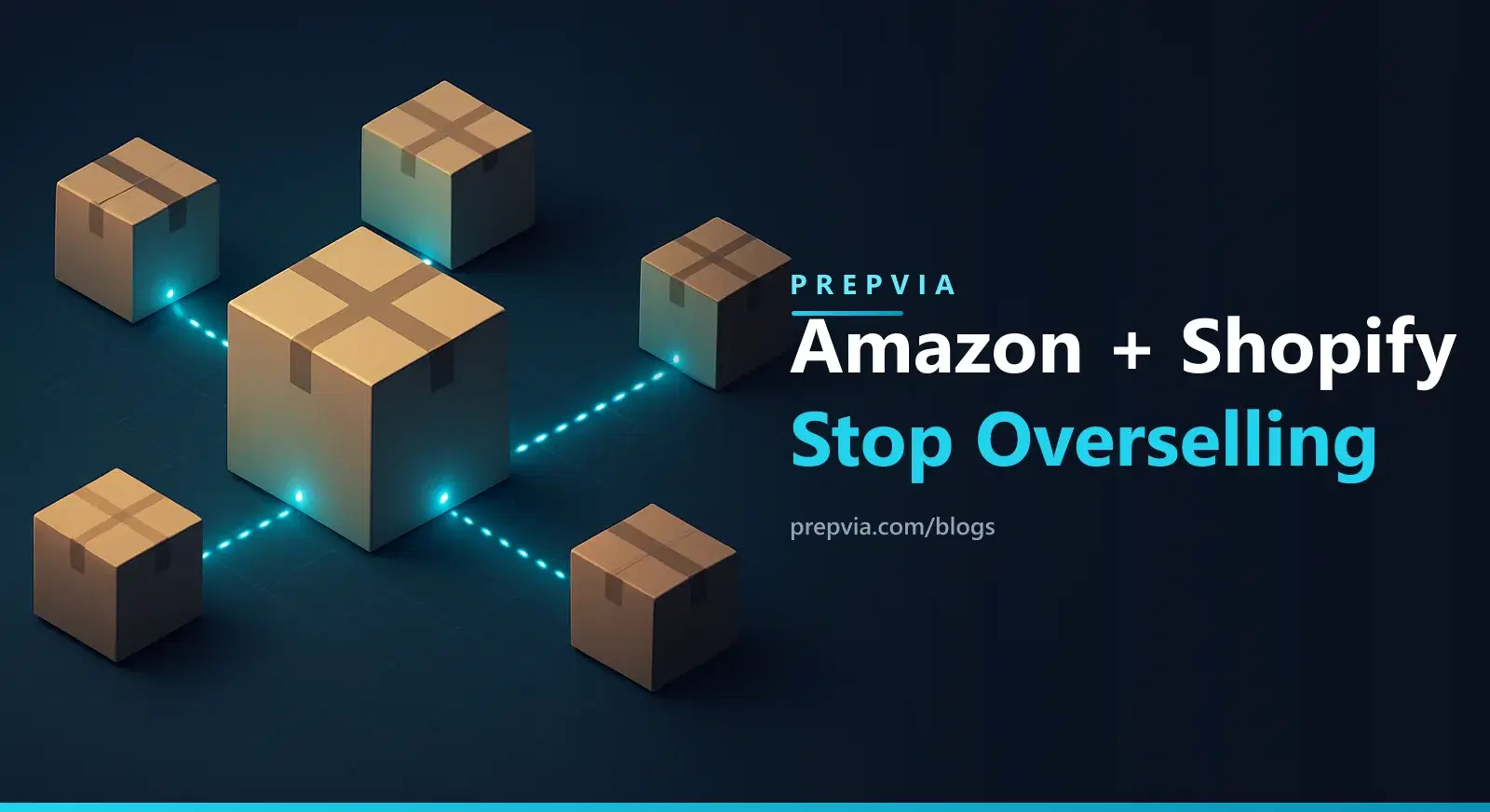
The single biggest risk in multichannel fulfillment is overselling - listing inventory on Shopify that has already been committed or shipped through Amazon. Overselling triggers order cancellations, customer complaints, and in severe cases, account-level penalties that can exceed $10,000+ when chargebacks, refunds, and lost Buy Box eligibility compound.
The official solution is the Amazon MCF and Buy with Prime app for Shopify. It connects your Shopify store directly to your FBA inventory and provides automatic inventory sync, automated order fulfillment, real-time tracking and notifications, and SKU mapping. Setup takes three steps: connect your Amazon account, map your Shopify products to your Amazon SKUs, and set shipping preferences. Once live, you manage one inventory pool across both channels.
MCF vs. 3PL: Where Each Model Wins
Using Amazon MCF for Shopify fulfillment is the fastest path to operational simplicity. But it comes with trade-offs that matter for DTC brands.
Amazon MCF wins on speed with Prime-grade 2-day shipping, simplicity with pay-as-you-go pricing and one inventory pool, and scale for demand spikes. A dedicated 3PL wins on branded packaging for unboxing experiences, carrier flexibility with wholesale rates, brand identity control to avoid Amazon boxes, and better economics for low-margin SKUs.
The Hybrid Model: How to Structure It
The most effective multichannel inventory management strategy in 2026 is not MCF or 3PL - it is both, deployed strategically.
Use Amazon MCF for high-velocity SKUs, healthy-margin products, deep-coverage markets, and unpredictable demand periods. Use a 3PL for Shopify-only SKUs, low-margin items, custom or subscription orders, and international markets. The key is a single source of truth for inventory across all channels in real time.
The Bottom Line
Multichannel fulfillment in 2026 rewards sellers who plan deliberately, not those who default to the easiest option. For invited merchants, MCF Preferred Pricing offsets part of the January increase, but for everyone else MCF got more expensive in 2026: fees up $0.30 per unit on average, plus the 3.5% surcharge from May 2 and holiday peak rates from October 15. Unbranded boxes and limited carrier control also mean it is not the right answer for every SKU or every customer. A 3PL fills the gaps MCF cannot: branded packaging, carrier negotiation, and the DTC identity that keeps Shopify customers coming back.
Build the hybrid. Sync the inventory. Let each channel play to its strengths.