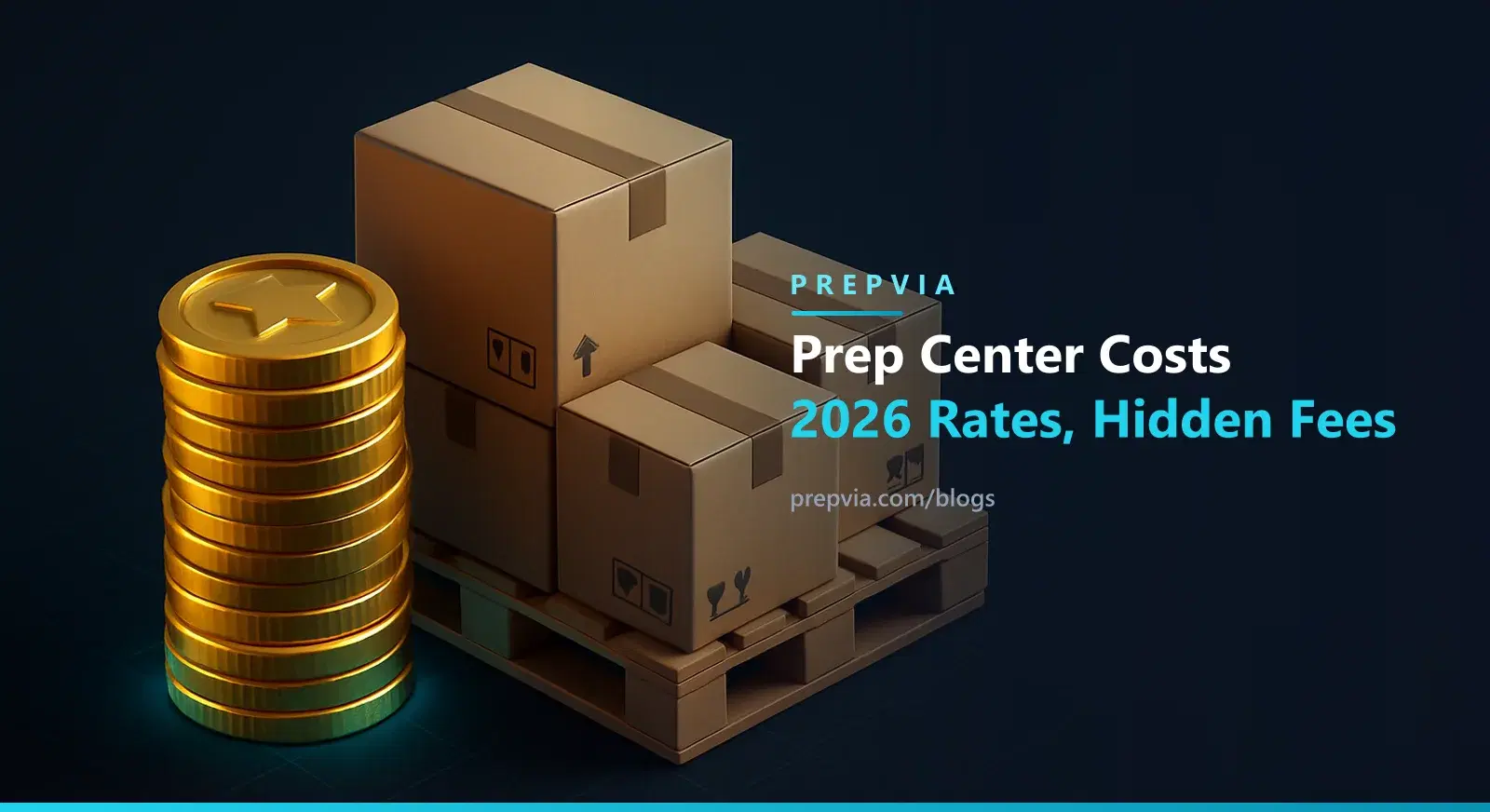
Short answer: a US prep center charges roughly $0.40 to $1.50 per unit for full service in 2026, plus receiving and storage. The cheap quote usually hides three fees: receiving per carton, a monthly minimum, and storage after a short free window. Compare total cost per unit shipped, not the advertised prep rate.
Amazon FBA Prep Center Costs: 2026 Pricing Guide and Fee Breakdown
If you're asking how much does an FBA prep center cost, the answer matters more in 2026 than it ever has. Amazon officially discontinued its own in-house FBA prep and labeling services on January 1, 2026. Every seller using Fulfillment by Amazon must now handle, or outsource, labeling, poly bagging, and bundling before inventory reaches a fulfillment center. Two exits remain: SIPP eligible products ship in their own packaging, and eligible items can use virtual tracking with the manufacturer barcode instead of an FNSKU label.
That single policy change turned third-party prep from a convenience into a requirement for most operations. This guide breaks down Amazon prep center cost structures, what drives them, and how to evaluate whether the investment pays for itself.
What Drives FBA Prep Center Pricing
FBA prep center pricing depends on three variables: your monthly volume, the complexity of your products, and the services you need. Most providers use a per-unit model where the base rate covers receiving, inspection, FNSKU labeling, and outbound box preparation.
Anything beyond that - poly bagging, bubble wrap, bundling, oversized handling - adds incremental charges. Volume discounts are significant. A seller moving 5,000 units per month might pay $0.95 per unit, while scaling to 50,000+ units drops that rate to $0.50 per unit.
| Service | Typical Cost |
|---|---|
| Base prep (incl. FNSKU labeling) | $0.40 to $1.50 per unit |
| Poly bagging | $0.20 to $0.50 per unit |
| Bubble wrap / protective packaging | $0.25 to $0.50 per unit |
| Bundling (multi-pack assembly) | $0.20 to $1.00 per additional unit |
| Sticker removal | $0.25 per unit |
| Oversized item handling (18"+) | $2.00 to $5.00 per unit |
| Carton forwarding | $3.00 to $5.00 per carton |
The Fees Most Sellers Overlook
The base FBA prep fees on a provider's pricing page rarely tell the whole story. Watch for these additions when comparing quotes: storage fees ($40 to $50+ per pallet per month), container unloading (about $200 to $350 for a palletized 20-foot and $300 to $600 for a palletized 40-foot, with floor-loaded containers running 30 to 60 percent higher), materials surcharges (boxes $1.70 to $4.80), and non-wholesale premiums ($1.00 to $1.50 per unit for arbitrage).
When evaluating the true Amazon prep center cost, request a fully itemized estimate based on your actual product mix - not a generic per-unit quote.
24 to 36h prep. 35-hour end-to-end guarantee or the prep is free. Net-30. No minimums.
Why Location Is a Strategic Decision
Location directly affects shipping time to Amazon FCs and inbound freight rates. Florida centers offer port proximity for imports and climate control for sensitive products. Midwest locations minimize transit to Amazon's dense network. West Coast serves Pacific supply chains.
The right location reduces forwarding costs and shortens the time from your dock to check-in. What it does not touch is the aged-inventory surcharge, which counts only the days a unit sits inside an Amazon fulfillment center. That clock starts at 181 days and climbs by band: stock at 12 to 15 months costs the greater of $0.30 per unit or $6.90 per cubic foot, and stock over 15 months the greater of $0.35 per unit or $7.90 per cubic foot.
The 2026 Compliance Factor
Amazon's 2026 restructuring added no new fee type. It merged the placement charge and the defect charge into a single inbound defect fee averaging $0.60 per unit, and that fee punishes misrouted, deleted, abandoned, incomplete, or late shipments, not labeling or bagging errors. Inbound defect fees jumped from $0.02 to $0.07 per unit to $0.32 to $1.74 per unit for standard items. For bulky products the fee tops out at $5.72 per unit on Large Bulky between 42 and 50 lb, with Small Bulky reaching $5.25.
The low-inventory-level fee stacks on top of that. It is not new, it has been live since April 2024, and in 2026 it runs $0.32 to $2.09 per unit, charged when both the 90-day and the 30-day historical days of supply fall below 28 days. Between the two, the cost of getting inbound wrong has increased dramatically. A professional prep center with 99%+ accuracy is margin protection.
Evaluation Checklist: Choosing the Right Prep Center
- Pricing transparency. Can they provide a line-by-line cost breakdown for your specific products?
- Turnaround time. Standard processing should be 1 to 3 business days. Ask about peak season.
- Software integrations. Dashboards or apps that sync with Seller Central for real-time tracking.
- Accuracy guarantees. Ask for their defect rate data.
- Scalability. Confirm they can handle 2x, 3x your current volume.
- Communication channels. Dedicated account managers or real-time support.
The Bottom Line
Understanding FBA prep center pricing is not about finding the cheapest option - it's about calculating total cost of ownership. Factor in per-unit rate, hidden fees, location-driven shipping costs, and penalty exposure avoided.
In 2026, with Amazon's own prep services gone and defect penalties at historic highs, the right prep center is less of an expense line and more of a growth lever.