
By Bernardo Campelo, Forbes Business Council E-Commerce Leader, Amazon SPN Certified provider, Amazon SP-API authorized partner, and Founder of PrepVia.
I have a running line with every seller I talk to. Amazon owes you money right now, and you are not going to ask for it. Most of them laugh. Then they go check. Then they stop laughing. The money is real, it hides in the gap between what you shipped and what Amazon actually checked in, and most of it only comes back if you file for it, with proof.
I have watched sellers leave thousands of dollars on the table on inbound shipments alone, not because the claims were hard, but because nobody reconciled the shipment and the clock ran out. So let me lay out where the money actually is, the deadlines that kill claims, and the one thing that decides whether you win a lost-inbound claim or lose it.
The 60-second version
When Amazon receives fewer units than you shipped, or loses and damages units inside a fulfillment center, you are owed a reimbursement. But you generally have to find it, document it, and file it before a window closes. Fulfillment center claim windows tightened in late 2024, the payout math changed on March 31, 2025, and both rules still govern claims in 2026. Lost and damaged claims inside a fulfillment center run on a 60 day clock counted from the date Amazon reports the unit lost or damaged. Inbound shipment claims run on a longer clock: you can file once the shipment shows as eligible for investigation in the Status column on the Contents tab of your shipping workflow, and you must file no later than nine months after the verified delivery date. Amazon accepts one claim per shipment, so the one you file has to be complete. The seller who reconciles shipped-versus-received gets paid. The seller who trusts Amazon to catch everything does not.
The 2025 policy change that shrinks your refund
Since March 31, 2025, Amazon values reimbursements for inventory lost or damaged before a customer order at your sourcing cost rather than the retail price, which can cut a refund by half or more compared with the old method. Sourcing cost is what you paid to get the product from a manufacturer, wholesaler, or reseller, or what it cost you to produce it if you are the manufacturer, without shipping, handling, or customs duties. The practical defense is to enter your own sourcing cost per SKU on the Manage Your Sourcing Cost page of the Inventory Defect & Reimbursement portal, because Amazon uses its own estimate, built from comparable products, when you do not. Two more rules sit on top: a unit that was already unsellable is reimbursed at a reduced estimated cost, and no single unit pays more than $5,000. Confirm the current policy and values in Seller Central, because Amazon keeps adjusting them.
The deadlines that quietly kill claims
Most lost reimbursement money is not denied. It is never filed in time.
| Claim type | Typical window | What triggers it |
|---|---|---|
| Lost or damaged in a fulfillment center | 60 days from the date Amazon reports the unit lost or damaged | Amazon loses or damages a unit it was holding |
| Inbound shipment discrepancy | Opens when the shipment shows as eligible for investigation; closes nine months after the verified delivery date. One claim per shipment | Amazon received fewer units than you shipped |
Confirm the current windows in Seller Central before you file. The point is the same either way: file early, not at the deadline.
24 to 36h prep. 35-hour end-to-end guarantee or the prep is free. Net-30 terms. From 50 units to full truckloads.
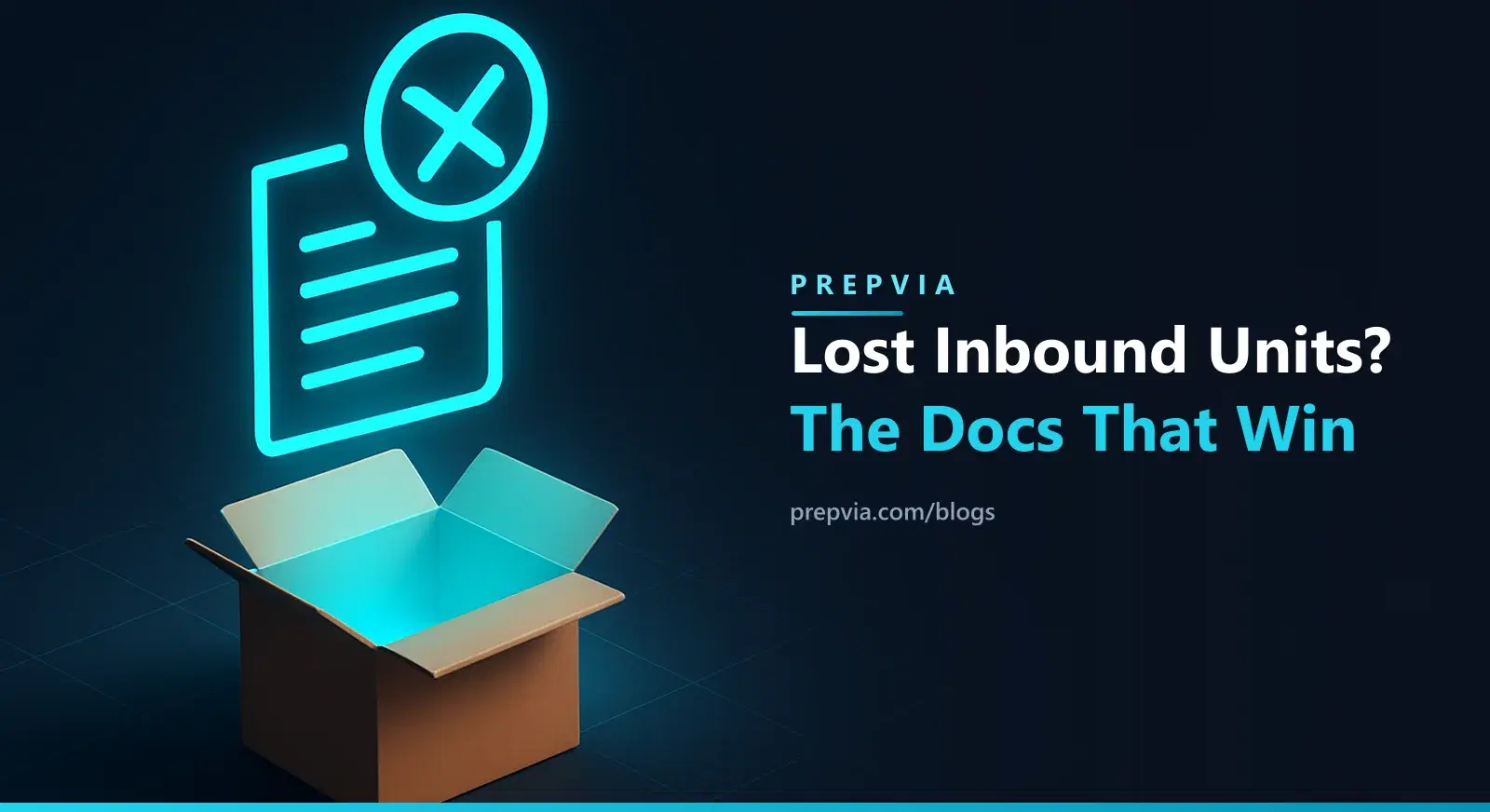
The one thing that wins a lost-inbound claim
Amazon does not reimburse a story. It reimburses evidence. For an inbound shipment that arrived short, a winning claim needs the bill of lading, carrier proof of delivery, the packing list, and an item-level record of exactly what shipped versus what Amazon checked in. That last piece is where a prep center matters. PrepVia’s scan-to-receive captures a per-unit record of what physically arrived, and the reimbursement view compares units shipped against units Amazon received and values the gap at your sourcing cost, the basis Amazon uses for inventory lost before a customer order, so the documentation is already built before there is a claim to file. How that receiving record works is in FBA inbound shipment tracking, and it is one of the thirteen tools every Amazon seller should expect from a prep center.
Frequently Asked Questions
Does Amazon automatically reimburse lost or damaged inventory, or do I have to file?
Amazon auto-detects and reimburses some cases, but a large share of what you are owed requires you, or a service, to file a documented claim before the window closes. Relying only on auto-reimbursement leaves money on the table, so reconcile shipped-versus-received yourself and file the gaps.
How long do I have to file an FBA reimbursement claim?
It depends on the claim type. Fulfillment center losses give you 60 days from the date Amazon reports the unit lost or damaged. Inbound shipment claims run longer: you can file once the shipment shows as eligible for investigation on the Contents tab, and Amazon accepts the claim until nine months after the verified delivery date, one claim per shipment. Confirm the current deadlines in Seller Central and file early rather than at the cutoff.
How does the 2025 sourcing-cost policy change my reimbursement?
For inventory lost or damaged before a customer order, Amazon reimburses your sourcing cost, what you paid the manufacturer, wholesaler, or reseller, instead of the sale price, so the payout is usually well below what the unit would have sold for, and it is capped at $5,000 per unit. Entering an accurate sourcing cost for each SKU on the Manage Your Sourcing Cost page is now the difference between a fair reimbursement and a low one.
What documents do I need for a lost inbound shipment claim?
Typically the bill of lading, carrier proof of delivery, the packing list, and an item-level record of what you shipped versus what Amazon checked in. The item-level reconciliation is the piece sellers most often lack, and it is what turns a short-received shipment into a paid claim.