
By Bernardo Campelo, Forbes Business Council E-Commerce Leader, Amazon SPN Certified provider, Amazon SP-API authorized partner, and Founder of PrepVia.
A seller forwarded me his Seller Central screenshot last month. Over a thousand dollars in inbound charges on a shipment he swore was labeled correctly, units Amazon could not trace and would not reimburse. He wanted to know who messed up. The uncomfortable answer was that the rules had changed under him, and nobody told him. As of 2026, labeling is not Amazon’s job anymore. It is the seller’s.
I have seen this same screenshot a dozen times since January, and every seller is asking the same first question: who is supposed to label my units now? That is the question this whole topic turns on, and most of the “FNSKU labeling service” pages out there never answer it. They explain what an FNSKU is and then try to sell you something. So let me do both halves honestly: what an FNSKU label actually is, and what it really costs to get one on every unit now that Amazon stopped doing it.
The 60-second version
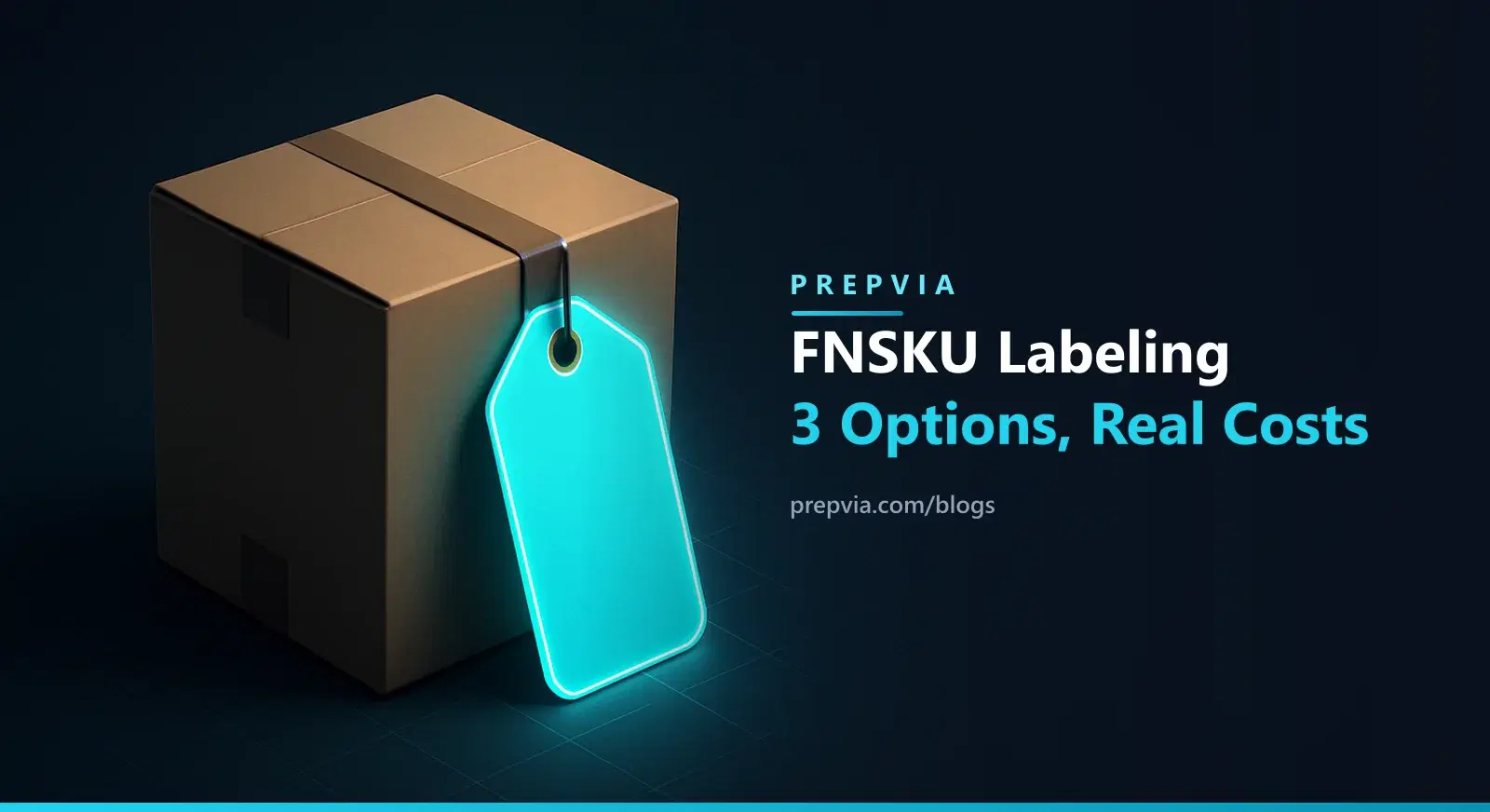
An FNSKU is the Amazon barcode that ties a physical unit to your account, and since the 2026 commingling change every seller who is not a Brand Registry brand owner has to put one on each unit, covering the manufacturer’s UPC so only one barcode scans at the fulfillment center. On January 1, 2026, Amazon ended its in-house $0.55-per-unit labeling service, and on March 31, 2026 Amazon ended commingling and began requiring an FNSKU from every reseller, authorized resellers included (confirm both in Seller Central). That leaves three ways to get it done: label it yourself, have your supplier do it, or use a prep center. The right choice is a cost-and-risk decision, not a default.
FNSKU, UPC, and ASIN: which one matters on the unit
These three codes get blurred constantly, and the confusion is exactly what gets shipments charged. The UPC or EAN is the manufacturer barcode that identifies the product, not your account. The ASIN is Amazon’s listing identifier and is not a scannable unit barcode at all. The FNSKU is the one that has to be on the physical unit, unless you are the brand representative shipping on the manufacturer barcode, because it is what ties that unit to your account. Since Amazon ended commingling on March 31, 2026, every reseller, authorized or not, has to apply it, so it is no longer a private-label-only concern. If you are still untangling the three, the guide on FNSKU vs UPC vs the manufacturer barcode covers it in full.
24 to 36h prep. 35-hour end-to-end guarantee or the prep is free. Net-30 terms. From 50 units to full truckloads.
What FNSKU labeling actually costs in 2026
There are three ways to get the label on, and the real gap is wider than sellers expect once you count equipment and your own time. These are typical industry ranges, confirm any provider’s exact rate on its pricing page, and confirm Amazon’s own fees in Seller Central.
| Option | Typical cost | The catch |
|---|---|---|
| Self-label | About $0.05 to 0.10 per unit, plus a $150 to 300 thermal printer | Your time, your error rate, and you eat the cost of every unit that will not scan |
| Prep center | About $0.20 to 0.40 per unit is the common band, with the wider 2026 market running $0.10 to $0.55 | Choose one that guarantees scan accuracy, not a vague promise to label |
| Amazon’s old service | Was $0.55 per unit, discontinued January 1, 2026 | No longer an option; the work moved to you |
The number that should scare you is not the labeling fee. It is the unit Amazon cannot trace. A label that looks fine but mis-scans at the fulfillment center can leave units unreceived or untraceable, and since January 2026 those units are not eligible for reimbursement. A stranded unit costs you the sale, the removal, the relabel and the re-inbound, many times more than the few cents you saved labeling it yourself, and repeat problems put your shipments and your account at risk. That is why the labeling step is really a compliance step, and why scan reliability matters more than price per label. PrepVia’s labeling lines run at 13,200 units per hour with 99.9% scan accuracy, and every FNSKU label carries two barcodes, a Code 128 and a Data Matrix, so a redundant code is always readable even on a bad angle or a worn thermal head. See how that runs on the labeling service page, and the per-unit rate on the pricing page.
Labeling used to be the part of FBA you could be lazy about, because you could pay Amazon to label for you. That service is gone. Amazon still sticks its own barcode on a unit that arrives without the one it needs, but it records the unit as a defect on your Inbound Performance Dashboard, a label in the wrong place can bring delays and unplanned prep service fees, and a unit from a shipment created since January 1, 2026 without the required prep or label is not reimbursed if it is damaged or cannot be traced. In 2026 a bad label is not a minor annoyance; it is a recorded defect, a delay, and a unit you may never be paid for. It is one of the thirteen tools every Amazon seller should expect from a prep center.
Frequently Asked Questions
How much does FNSKU labeling cost per unit?
Self-labeling runs about $0.05 to $0.10 per unit in materials plus a $150 to $300 thermal printer. Prep centers commonly charge $0.20 to $0.40 per unit for labeling, with the wider 2026 market running $0.10 to $0.55. Amazon’s own $0.55-per-unit service was discontinued on January 1, 2026. Confirm any provider’s exact rate on its pricing page.
Did Amazon discontinue its FBA labeling service in 2026?
Yes. Per Amazon’s announcements, the in-house FNSKU labeling service ended January 1, 2026, and since Amazon ended commingling on March 31, 2026, every reseller, authorized resellers included, needs its own FNSKU. Verify the current policy in Seller Central before planning around it.
Do I have to cover the manufacturer barcode with the FNSKU?
Yes. The FNSKU label must cover or replace the visible manufacturer UPC or EAN so the fulfillment center scans exactly one barcode on the unit. If both are visible, the scanner can read the wrong one, which causes mis-scans, misattributed units, or rejections.
Should I self-label or use a prep center?
It is a cost-and-risk decision. Self-labeling is cheaper per unit but costs your time and leaves the risk of unreadable units with you. A prep center costs more per unit but should guarantee scan accuracy, which is what keeps units from arriving unreadable, unreceived and, since January 2026, ineligible for reimbursement.