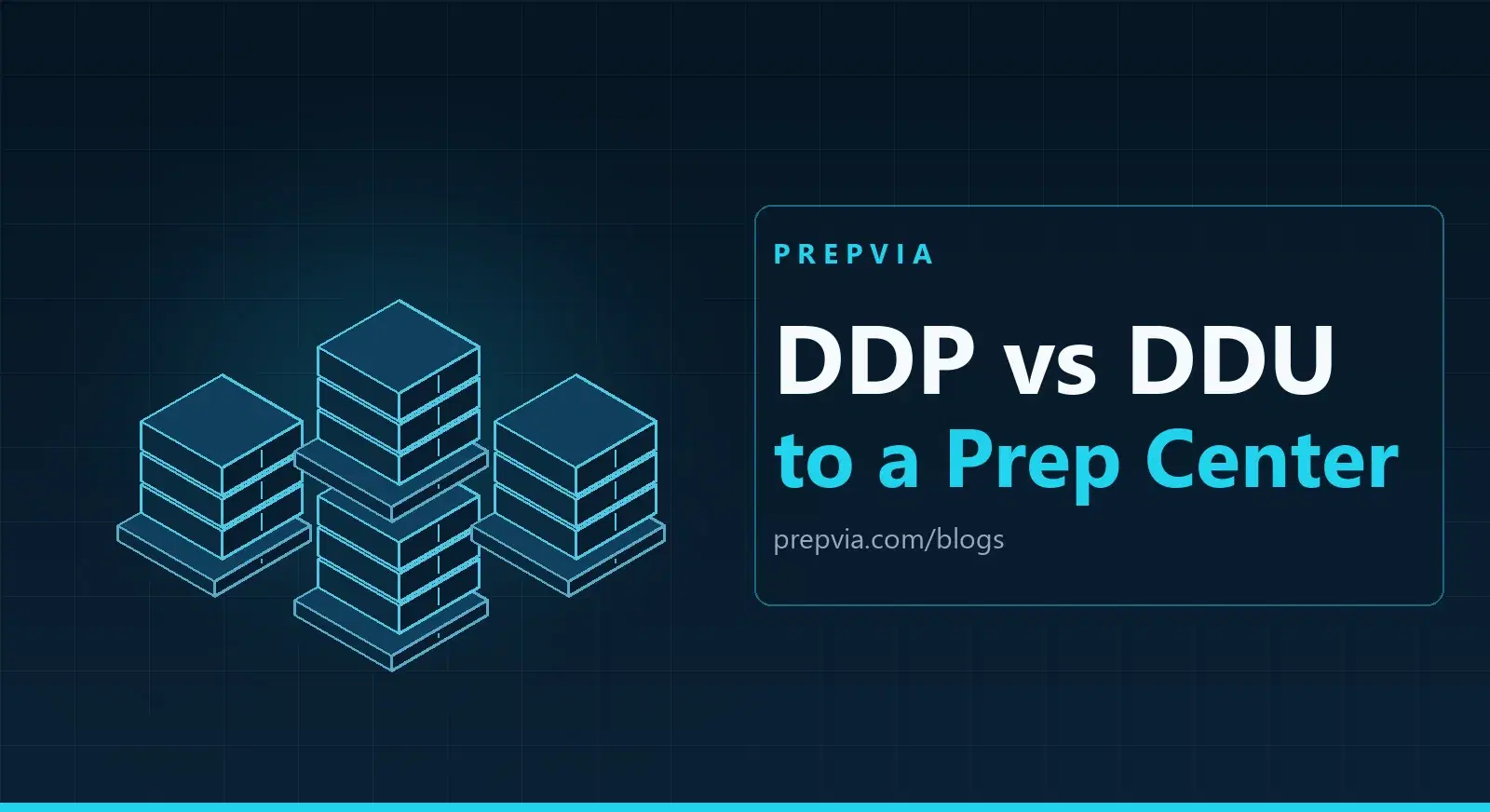
DDP vs DDU When Your Destination Is a Prep Center
DDP or DDU (DAP) for a shipment landing at a US prep center: who is importer of record, who pays duty, the undervaluation trap, and what your dock needs.

By Bernardo Campelo, Forbes Business Council E-Commerce Leader, Amazon SPN Certified provider, Amazon SP-API authorized partner, and Founder of PrepVia.
Most container quotes an Amazon seller receives from China come in two flavors: DDP, where the supplier or forwarder delivers to your door with duties paid, and DDU, the older name for what Incoterms now call DAP, where the goods arrive at your door and the duties are yours. When the door is a prep center in Miami, the choice decides who the importer is, who answers to Customs, and what the dock can and cannot do when the truck shows up.
The 60-second version
DDP: the seller or forwarder is importer of record, clears customs, pays duty, delivers. Simple, and the entry record is theirs, not yours.
DDU / DAP: you are importer of record: an EIN or customs-assigned number, a bond, a broker, and control of the classification and the paperwork.
Either way, the dock needs the same things: a packing list per carton, a delivery appointment, and a named party for drayage and detention.
The Incoterms That Matter for FBA
| Term | Seller handles | You handle | Typical use in FBA sourcing |
|---|---|---|---|
| EXW (Ex Works) | Makes the goods available at the factory | Everything from the factory door onward | Rare; only with a forwarder who manages origin pickup |
| FOB (Free on Board) | Export clearance and loading on the vessel | Ocean freight, insurance, US entry, drayage | The common term for sellers who use their own forwarder |
| DAP (Delivered at Place), formerly DDU | Freight to the named US address | Import entry, duty, taxes; usually the unload | Door delivery with you as importer of record |
| DDP (Delivered Duty Paid) | Freight, import entry, duty, delivery to the address | Receiving the goods | The all-in quote most Chinese forwarders push |
DDP: Simple, With a Catch
Under DDP the party delivering the goods is the importer of record. They file the entry through their broker, on their bond, and declare the value and the classification. You receive a landed price and a delivery. For a first shipment it removes the setup work of becoming an importer, and that is the honest appeal.
The catch is that the entry is not yours. Two consequences follow. First, undervaluation. A DDP quote that looks too good next to a DAP quote plus your own duty estimate is often too good because the declared value was lowered or the HTS code was chosen to minimize duty. Under 19 USC 1592 a consignee who participates in or ignores a false declaration can be penalized, and holds, penalties and seizures land on the goods, which are yours. Second, records. When Amazon disputes a shipment, when a product needs an FDA or CPSC document trail, or when you sell the business, the import record sits with a forwarder you may never reach again.
DDU / DAP: You Are the Importer
Under DAP the goods arrive at the named address, but the entry is yours. That means an EIN, or for foreign sellers a customs-assigned importer number; a customs bond, single-entry for a one-off or continuous for a regular flow; in practice, a licensed customs broker who files the entry, though an importer can self-file in ACE; and your own decisions on HTS classification and valuation. It is more setup and it is more control: the record is yours, the classification is defensible because you chose it, and the duty you pay is the duty you owe.
Our guide to customs documents for an FBA import lists everything that has to exist before the container is released.
What Changes at the Dock
The prep center is the delivery address in both cases and, in the normal arrangement, it is not the importer of record. What changes is who the dock talks to when something goes wrong. Under DDP, the forwarder's drayage carrier delivers, and detention on a late unload is billed by the trucker (and per diem by the ocean line) to the forwarder, not to you. Under DAP, your broker releases, your forwarder drays, and the clocks are yours. The dock needs the same inputs regardless:
- A packing list per carton. SKU, units per carton, carton count, weights, and the ASIN map. This is the document the dock counts against.
- A delivery appointment. Date, morning slot, floor-loaded or palletized, so the crew is booked.
- A named party for drayage and detention. Who books the truck, who pays if the empty returns late.
- The FBA plan. One fulfillment center with the placement fee or the Amazon-optimized split, and the prep services per SKU.
- Proof of release. The dock should know the container is customs-released before the drayage carrier is dispatched.
Floor-loaded or palletized, near PortMiami and Port Everglades, then on to Amazon by partnered LTL or FTL.
The Decision, in Practice
- it is a first shipment and you are not yet set up as an importer
- the forwarder is known to you, and the declared value matches your invoice
- the product carries no partner-agency requirements (no FDA, CPSC or FCC paperwork)
- you ship regularly and a continuous bond amortizes across entries
- you need the import record for Amazon, for compliance, or for a future sale of the business
- the duty exposure is large enough that classification control matters
Frequently Asked Questions
What is the difference between DDP and DDU for Amazon FBA shipments?
Under DDP the seller or forwarder acts as importer of record: they file the entry, pay duty and deliver to your address, and the import record is theirs. Under DDU, called DAP in current Incoterms, the goods are delivered to your address but you are the importer: you need an EIN or customs-assigned number, a bond and a broker, you pay the duty, and the record is yours. The prep center is the delivery address in both cases and, in the normal arrangement, is not the importer of record.
Is a DDP quote from a Chinese forwarder safe?
It can be, and the way to know is the entry summary. Ask for CBP Form 7501 after clearance and compare the declared value and HTS code to your commercial invoice. A large gap means the price was built on undervaluation or misclassification, and the goods, which are yours, carry the risk of holds and penalties. A DDP quote that is far below a DAP quote plus your own duty estimate deserves that check before the container sails.
Can a prep center be the importer of record?
Not in the normal arrangement. The prep center is the named delivery address on the shipment and receives the goods after customs release. The importer of record is the seller under DAP, or the delivering party under DDP. What the dock needs is the packing list, a delivery appointment, a named party for drayage and detention, and confirmation that the container is released before the truck is dispatched.
What documents does a prep center need for a DDP delivery?
The same as for any container: a packing list per carton with SKU and units, the ASIN map, the delivery appointment, and the forwarder's contact for the drayage leg. It is also worth requesting the entry summary from the DDP party for your own records, since Amazon disputes and compliance questions later depend on it.
Send PrepVia your packing list and delivery date →
24-36 hours standard prep · FastLane 35H: 35 hours end to end or the prep is free · Net-30 · 8507 NW 72nd St, Miami, FL 33166
Continue reading
- Customs Documents for an FBA Import: the full list, who prepares it and when
- Container Unloading in Miami: the drayage leg and the dock
- Your First Q4 Without De Minimis: why consolidated freight replaced parcels
Stop managing prep. Start shipping.
We prep in 24 to 36 hours and guarantee 35 hours end to end, or the prep is free. No minimums, up to full truckloads, and you pay Net-30.