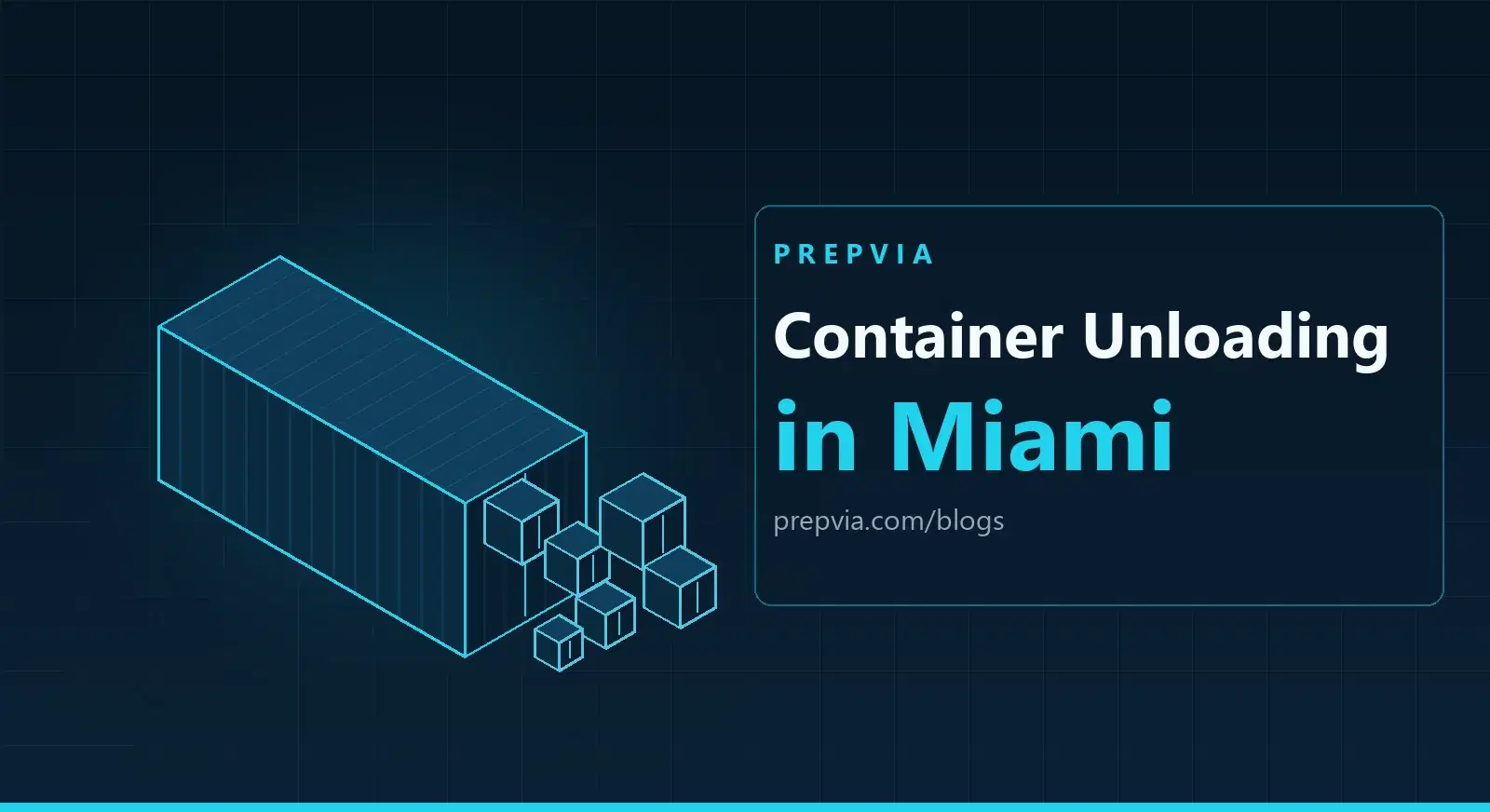
Container Unloading in Miami for Amazon FBA Sellers
Unloading a container in Miami before Amazon FBA: PortMiami and Port Everglades volumes, drayage rates, what devanning costs, and what the dock does next.

By Bernardo Campelo, Forbes Business Council E-Commerce Leader, Amazon SPN Certified provider, Amazon SP-API authorized partner, and Founder of PrepVia.
South Florida moves more than 2.2 million TEU a year through two ports that sit forty minutes apart. PortMiami handled over one million TEU in 2025 and Port Everglades reported 1.167 million TEU for the same year. For an Amazon seller importing from Asia through the Panama Canal, or from Latin America and the Caribbean, the container is very likely to land here. The question is what happens in the first 72 hours after it does.
The 60-second version
Two ports, one dock: PortMiami and Port Everglades feed the same warehouse belt west of the airport. A short drayage run puts the container on a dock the same day it is released.
The numbers: drayage from PortMiami to a local warehouse commonly 350 to 650 dollars; unloading a palletized 40-footer commonly 300 to 600 dollars, 30 to 60 percent more when floor-loaded; receiving 8 to 15 dollars per pallet.
After the dock: count, inspect, palletize, prep, and forward to the fulfillment center. PrepVia's standard prep window is 24-36 hours.
Why Miami, in Numbers
The United States imported 28.1 million TEU in 2025, 0.4 percent below 2024 according to the monthly Descartes import reports. Within that total, the Florida Atlantic coast is the natural entry for two flows: Asian cargo routed through the Panama Canal to the East Coast, and everything from Central and South America and the Caribbean. PortMiami ranks among the top dozen US container ports; Port Everglades, in Fort Lauderdale, is its twin to the north. Both have grown their container terminals to receive larger post-Panamax vessels.
The warehouse belt that serves both ports runs along the Palmetto and the Turnpike, through Doral, Medley and Hialeah. PrepVia's dock is in that belt, at 8507 NW 72nd St, Miami, FL 33166, open Monday to Saturday, 9 AM to 5 PM ET.
The Drayage Leg
Drayage is the truck move from the terminal to your dock. In Miami it is priced per container and the 2025 and 2026 guides from local drayage carriers put a port-to-warehouse move in the 350 to 650 dollar range depending on destination, chassis availability, terminal wait time and fuel. The forwarder usually books it, but the dock can too. What matters is that the drayage carrier has the delivery address, the dock hours, and a booked appointment before the container is released.
Where to Unload: Three Options
| Option | How it works | Best for | Watch out for |
|---|---|---|---|
| Port transload | A terminal-adjacent warehouse moves the cargo from the container to trailers | Freight that continues by truck to another state without inspection | No SKU-level count, no prep, nothing fixed before Amazon sees it |
| Prep center dock | The container is drayed to the prep center, unloaded, counted, palletized and prepped on site | Anything going to Amazon FBA, especially mixed SKUs and factory cartons | Book the dock early; unloading capacity in peak season is finite |
| Direct to an Amazon FC | The container goes to the fulfillment center as an FTL freight appointment | Fully compliant, pre-prepped loads only, on pallets or floor-loaded, since an FTL or intermodal load can arrive floor-loaded under Amazon's Floor Loading Policy | Refusal, unplanned prep fees, or inbound defect fees of $0.32 to $5.72 per unit if the load differs from the shipping plan |
What Devanning Actually Includes
Devanning is the industry word for unloading a container, and a proper one is more than moving boxes. The crew counts cartons against the packing list as they come off. Every carton is checked for transit damage: crushed corners, water marks, broken tape, and the photographs go into the receiving record. SKUs are verified against your ASIN map, because a master carton labeled one thing and holding another is a routine finding. Then the cartons are palletized by SKU, wrapped, and labeled, so the prep line can pull one product at a time.
Floor-loaded or palletized, near PortMiami and Port Everglades, then on to Amazon by partnered LTL or FTL.
From the Dock to the Fulfillment Center
Once palletized, the load goes to prep: FNSKU labeling, poly bagging, expiration dating, bundling, whatever the listing requires. PrepVia runs a 24-36 hour standard prep window from receiving to ready, with an automated labeling line rated at 13,200 labels per hour and 99.9% scan-verified accuracy. Then the shipment plan is created and the outbound truck is booked.
Two Florida details help here. Amazon operates fulfillment centers in the state, so a single shipment to the closest FC can be a short haul rather than a cross-country move; our guide to the inbound placement fee explains why paying for that single shipment usually beats the free split. And PrepVia's FastLane 35H covers the whole stretch: 35 hours end to end or the prep is free. The details are on the FastLane page.
Timing a Container in Peak Season
Q4 changes the arithmetic. Terminals are busier, chassis are scarcer, and Amazon's own inbound windows close on published dates. Our Q4 2026 inventory deadlines guide counts backward from those dates; a container that has to clear customs, dray, unload, prep and inbound before them needs to be on the water weeks earlier than most first-time importers assume. Chinese New Year adds a second cliff on the origin side, covered in the Chinese New Year 2027 plan.
What the Dock Needs From You
- The packing list, before the vessel docks. Carton count, SKU and units per carton, weights, ASIN map.
- The forwarder's contact and the drayage plan. Who releases, who drays, who to call when the terminal is late.
- Floor-loaded or palletized. The unload plan and the crew depend on it.
- The FBA plan. One FC or split, prep services per SKU, expiration rules if the product has dates.
- Special handling flags. Fragile, hazmat, meltables, oversize. Each changes where the pallets go after the count.
Related service pages: wholesale FBA prep at volume, 3PL prep center for Amazon sellers.
Frequently Asked Questions
How much does container unloading cost in Miami?
Published 3PL benchmarks for 2026 put the unload of a palletized 40-foot container at roughly 300 to 600 dollars, 30 to 60 percent more when floor-loaded, with receiving on top at about 8 to 15 dollars per pallet built. Drayage from PortMiami or Port Everglades to a warehouse in the Doral and Medley belt is a separate line, commonly 350 to 650 dollars per container. Palletized containers unload faster and cheaper than floor-loaded ones.
Which port should my forwarder route to, PortMiami or Port Everglades?
Both serve the same warehouse belt and the drayage difference is small. The choice usually follows the carrier and the service string your forwarder has contracted; Asian cargo through the Panama Canal and Latin American cargo both call at each. What matters more is that the dock appointment, the packing list and the drayage carrier are lined up before the vessel arrives.
Can PrepVia receive a container directly from the port?
Yes. After customs release, the drayage carrier delivers the container to our dock at 8507 NW 72nd St in Miami, where it is unloaded, counted against the packing list, photographed, palletized by SKU and moved to prep. From there the goods go to Amazon as an FBA shipment, or into storage until the shipment plan is ready.
What happens if the container arrives outside dock hours?
It waits, and the waiting is billed as detention on the container. Our dock receives Monday to Saturday, 9 AM to 5 PM ET. The fix is to schedule the drayage delivery for a morning slot so the unload finishes and the empty returns the same day.
Schedule a container receiving in Miami →
24-36 hours standard prep · FastLane 35H: 35 hours end to end or the prep is free · Net-30 · 8507 NW 72nd St, Miami, FL 33166
Continue reading
- Container to Amazon FBA: the five legs from the port to the fulfillment center
- Customs Documents for an FBA Import: what has to be filed before the container is released
- Air vs Ocean to Amazon FBA: when the container is the right choice at all
- PrepVia Miami: the dock, the hours, the address
Stop managing prep. Start shipping.
We prep in 24 to 36 hours and guarantee 35 hours end to end, or the prep is free. No minimums, up to full truckloads, and you pay Net-30.