
By Bernardo Campelo, Forbes Business Council E-Commerce Leader, Amazon SPN Certified provider, Amazon SP-API authorized partner, and Founder of PrepVia.
August is when the capacity messages start. A seller opens the Capacity Monitor expecting the usual number and finds next month's estimated limit cut nearly in half. His IPI is fine. His sell-through is fine. Nothing on the account changed. The limit just dropped, and there is a container on the water that was sized against the old number.
This stopped being an edge case with the May 2025 reduction. Sellers have reported cuts of up to 75 percent, on accounts with IPI scores above 550. Amazon moderators and support have answered in writing, as recently as late 2025, that there is no override for a capacity limit. The limit is the limit. What Amazon offers instead is a bidding tool, a fee schedule, and a set of mechanics that most sellers only learn after they are already blocked from creating a shipment.
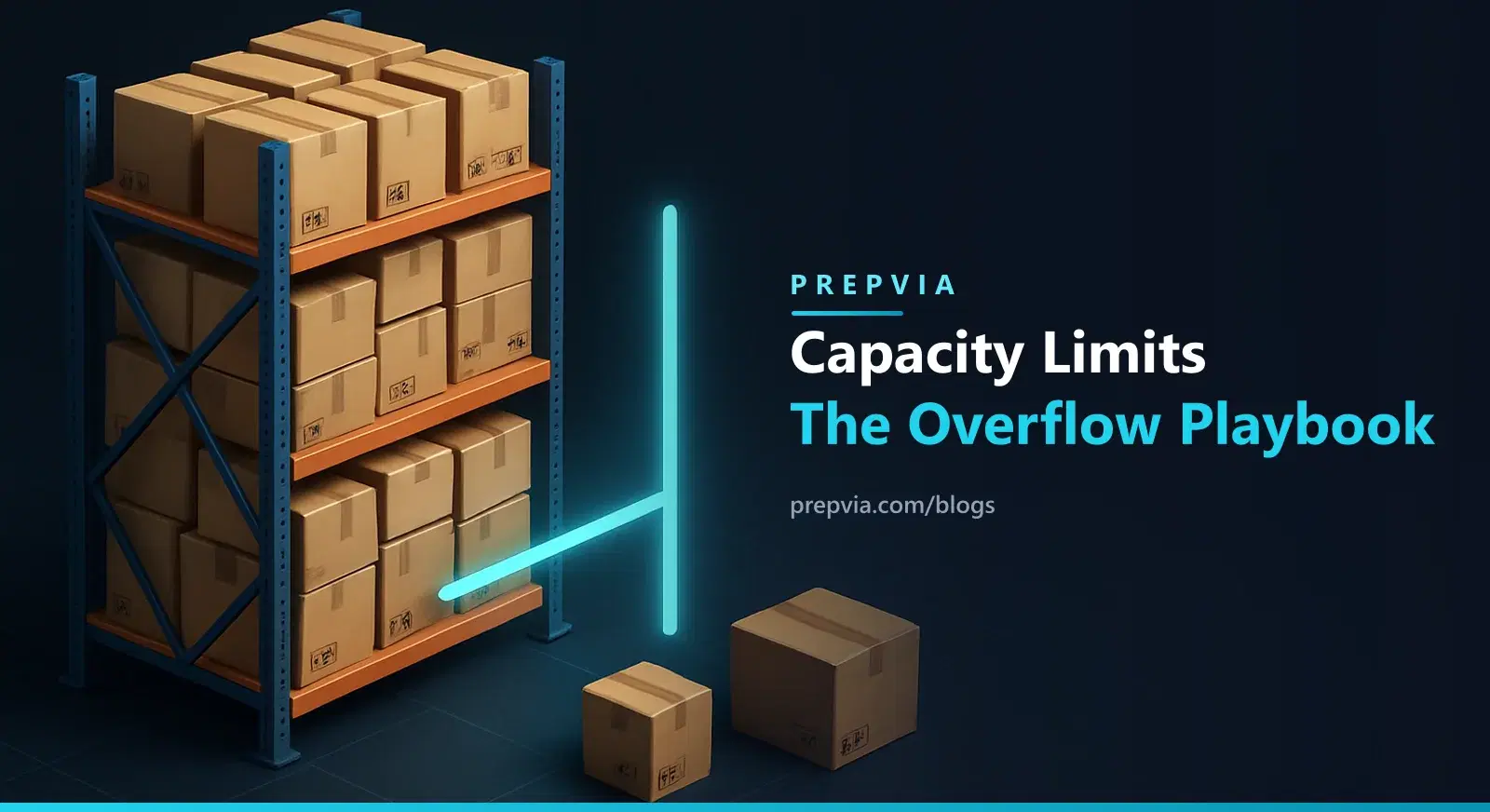
This is the playbook we run at PrepVia when the number comes in low: how the limit is actually set, how the Capacity Manager bid works and where its timing trap hides, when paying is genuinely cheaper than not paying, and how to keep a listing selling straight through a cut by using a 3PL as the pressure tank.
The 60-second version
The model: FBA capacity is granted monthly, in cubic feet, driven mostly by Amazon's forecast of your sales (roughly five months of projected volume as of 2026) and by space in the network. A high IPI keeps you out of the worst tier. It does not protect you from a network-wide cut, and sellers with IPI over 500 are reporting cuts anyway.
The tool: Capacity Manager lets you bid a reservation fee per cubic foot for a specific month. Highest bids are granted first, at your fee or lower, and performance credits earned at $0.15 per $1 of FBA sales from the extra space can offset up to 100 percent of the fee, as of 2026.
The trap: the increase applies in the target month. Amazon may open it up to one month early, at its discretion. Sea freight that needs a shipment plan created earlier than that gets blocked at creation, with the increase already granted.
The playbook: receive the bulk at a 3PL, then drip-feed weekly shipments sized to the capacity you actually have. The listing never goes dark and nothing ages inside an Amazon fulfillment center at peak storage rates.
How the 2026 Capacity Model Actually Sets Your Number
The current system replaced the old restock limits with a monthly grant measured in cubic feet, not units: a confirmed limit for the current month, plus estimates for upcoming months that can move before they are confirmed.
What feeds the number matters more than the number, because it tells you which levers you actually hold.
| Input | What it does to your limit | Can you influence it? |
|---|---|---|
| Amazon's forecast of your sales | One of the main inputs, alongside IPI, historical sales, scheduled deals, and fulfillment center capacity. As of 2026 the grant targets roughly five months of projected sales volume, down from about six. Slower forecast, smaller limit. | Slowly. Velocity, listing health, and steady sell-through raise the forecast over months, not weeks. |
| IPI score | Gates which tier you sit in. Below the threshold your limit is squeezed hard; above it you get the standard treatment. | Yes. Excess inventory, sell-through rate, stranded inventory, and in-stock rate are the four inputs that move it. |
| Network-wide space | When Amazon's own buildings run tight, limits get cut across a whole storage type at once, regardless of individual performance. | No. This is the lever behind the 2026 cuts. |
| Storage type | Standard-size, oversize, extra-large, apparel, and footwear each carry a separate limit, and dangerous goods are handled separately. You can be blocked in one and open in another. | Only through product mix. |
| Season | Q4 demand for space compresses everything and makes bid competition sharper. | No, but you can time your requests around it. |
The second cap almost nobody checks: per-ASIN limits
Since Amazon reintroduced ASIN-level caps in 2025, there are two ceilings, not one. Your account can show thousands of cubic feet of free capacity while one specific ASIN is capped at a number of units that has nothing to do with your account limit. Before you diagnose anything, check both: the account limit in the Capacity Monitor and the per-ASIN maximum shown at shipment creation. The fix for one is a bid. The fix for the other is velocity on that ASIN, and in the short term, a smaller and more frequent shipment cadence.
Why Yours Dropped With an IPI Over 500
The IPI myth dies hard because it used to be mostly true: keep the score healthy and the storage limit stayed out of your way. The 2026 reality is that IPI protects you from the punitive tier, and that is all it does. The size of the standard grant is set by the sales forecast and by how much room Amazon's network has, and when the network tightens, the cut lands on everyone in the affected storage type.
The limit is not a judgment about your account. It is an allocation of a physical building. The forecast decides your slice. The network decides the pie. The only market-clearing mechanism Amazon offers is the auction in Capacity Manager.
How the Capacity Manager Bid Actually Works
Capacity Manager is an auction with a rebate attached. The mechanics, verified against how the tool behaves as of 2026:
You bid a reservation fee per cubic foot. You name the additional cubic feet you want, the month you want them for, and the maximum reservation fee per cubic foot you are willing to pay. Amazon grants requests starting with the highest fee offered, and your request can be granted at your number or at a lower one. Reported winning bids typically land in the tens of cents per cubic foot, with Q4 months running more competitive than the rest of the year.
Performance credits can erase the fee. For every $1 of FBA sales generated with the additional capacity, you earn $0.15 of performance credit against the reservation fee, up to 100 percent of it, as of 2026. Sell enough through the extra space and the capacity costs you nothing. The credit preview updates daily, so you can watch the offset accumulate during the month.
Run the arithmetic before you bid, because it changes how aggressive you can afford to be:
| Line | Example |
|---|---|
| Additional capacity requested | 2,000 cubic feet for the target month |
| Reservation fee bid | $0.35 per cubic foot |
| Maximum fee exposure | $700 |
| FBA sales needed to offset 100 percent (at $0.15 per $1) | About $4,700 sold through the additional space |
| Real cost if the inventory sells | $0 |
| Real cost if it does not | The full $700, which is the point: the bid is a bet on your own velocity |
For inventory you are confident will sell, the rational bid is higher than most sellers' instinct, because the expected cost after credits is near zero and losing the auction costs you the month. For speculative inventory, the reservation fee is real money and the honest comparison is against 3PL storage, which is where the next section goes.
The timing trap that catches sea freight
This is the single most expensive misunderstanding in the tool. Sea freight works on 30 to 45 day lead times plus origin production. A seller who wins November capacity in October has solved the problem for air freight and for domestic inventory, and has solved nothing for the container that needed its shipment plan in September. The container arrives, cannot be inbounded, and either sits at the port racking storage charges or gets diverted somewhere that can receive it.
That somewhere is the actual answer, and it should be arranged before the container sails, not after it lands.
24 to 36h prep. 35-hour end-to-end guarantee or the prep is free. Net-30 terms. From 50 units to full truckloads.
Bid, Pay Overage, or Stage at a 3PL: the Real Comparison
Three ways to handle inventory that exceeds the limit, and they are not close.
| Option | What it costs | The catch |
|---|---|---|
| Pay the storage overage fee | $10 per cubic foot per month as of 2026, charged on the daily average volume above your limit | It cannot be offset by anything, and it is barely even an option: Amazon blocks shipment creation when on-hand plus inbound exceeds the limit, so overage is mostly a penalty for a limit that dropped after your inventory was already inside |
| Bid in Capacity Manager | Your reservation fee per cubic foot, typically a two-digit number of cents, offset up to 100 percent by performance credits if the inventory sells | Granted highest-bid-first, and the increase lands in the target month, which strands sea freight that needed an earlier shipment plan |
| Stage overflow at a 3PL | Pallet storage plus a prep-and-forward charge per shipment; see the pricing page | Adds a leg to the supply chain, so it only works with a partner whose turnaround is measured in days, not weeks |
The overage fee deserves one more sentence, because sellers sometimes treat it as a plan: send everything, eat the fee, keep selling. As of 2026 that plan usually dies at shipment creation, because the block happens before the overage does. The fee mostly exists to tax inventory that was legally inside the limit until the limit moved. Nobody should be paying it on purpose at $10 per cubic foot when 3PL storage for the same cube costs a small fraction of that, and December inside an Amazon FC also carries peak storage rates on top, which is its own comparison and we ran it in Q4 peak storage fees: FBA vs 3PL.
The Drip-Feed Playbook
When Amazon caps how much you can hold, the operational answer is to stop treating FBA as your warehouse and start treating it as your shelf. The warehouse moves upstream, to a 3PL or prep center that is not capacity-limited, and FBA holds only what the next few weeks of sales need. The mechanics:
- Receive the container at the 3PL, not at Amazon. The full quantity lands, gets counted and stored domestically. Nothing waits at a port and nothing depends on a bid you have not won yet.
- Set the replenishment target from days of supply. Weeks of cover at current velocity, with in-transit units counted. The math is the same days-of-supply discipline from the days of cover post, run weekly instead of quarterly.
- Size each shipment to available capacity minus open inbound. Open shipments count against the limit at creation, so the usable number is never the headline number. Small, frequent shipments fit through gaps that one big shipment cannot.
- Watch the per-ASIN caps separately. A weekly cadence handles them naturally: as units sell, the cap refreshes and the next drip fits under it.
- Hold the floor at the low inventory threshold. The drip has to keep days of supply above the 28-day line or you trade an overage problem for a low inventory level fee problem. The corridor between the two fees is exactly where the cadence lives.
- Re-bid every month that matters. Capacity Manager requests are per-month. October, November, and December are three separate auctions, and the drip cadence widens or narrows with each result.
One structural alternative deserves a mention: Amazon's own upstream option, AWD, holds bulk inventory in Amazon's distribution network and replenishes FBA automatically, with its own cost structure and its own constraints. For some import-heavy catalogs it is the right answer, for others a 3PL keeps more control per dollar. We compared the two in detail in AWD vs 3PL in 2026.
Why August Is When This Gets Decided
The reason this post exists in late August and not in November is lead time, stacked three deep.
First, the auction: capacity requests for October and November are being placed now, and Q4 bids clear at sharper prices as the quarter approaches. Second, the freight. A container that feeds November sales is being booked now. Where it lands, an FC that may not let it in or a 3PL that will drip it in, has to be decided before the bill of lading is cut. Third, the prep capacity itself: overflow programs at prep centers get committed in August and September, and a partner picked in November is a partner chosen from whoever still has floor space.
At PrepVia in Miami, Florida, the overflow program is exactly the loop described above: container receiving, storage, weekly replenishment shipments prepped inside a guaranteed turnaround SLA, with inventory and shipment status visible in the PrepVia dashboard instead of a weekly email thread. The point is not the brochure. The point is that a capacity cut is only an emergency for sellers whose entire inventory position lives inside the thing that got cut.
Frequently Asked Questions
Why did my FBA capacity limit drop when my IPI is over 500?
Because the limit is driven by Amazon's forecast of your sales and by physical space in the fulfillment network, not by IPI alone. Since May 2025 sellers have reported cuts of up to 75 percent on accounts with IPI scores above 550, and Amazon has confirmed in writing that limits cannot be manually overridden. A healthy IPI keeps you out of the most restricted tier, but it does not protect you when Amazon reduces space across an entire storage type. The working response is to bid for the months you need and stage the rest at a 3PL.
Is it cheaper to bid for capacity or pay overage fees?
Bidding, in almost every case. The overage fee runs $10 per cubic foot per month as of 2026 and cannot be reduced by anything, while a granted reservation fee is typically a fraction of a dollar per cubic foot and can be offset up to 100 percent by performance credits earned at $0.15 per $1 of FBA sales through the extra space. Overage also only applies once inventory is already over the limit, and Amazon usually blocks shipment creation before that point, so overage is not really an inbound strategy at all.
What do I do when Amazon blocks creating a shipment over capacity?
First check whether the block comes from the account-level limit or from a per-ASIN cap, because the fixes are different. Then submit a Capacity Manager request for the month you actually need, sized in cubic feet with a bid you can defend with expected sales. While the request is pending, route the freight to a 3PL or prep center instead of letting it wait at a port, and keep sending smaller shipments that fit inside the capacity you still have. A blocked shipment plan almost never has to mean a dark listing if the inventory is staged domestically.
How does drip-feeding inventory from a 3PL to FBA work?
The full container is received and stored at the 3PL, and each week a smaller replenishment shipment is prepped and sent to Amazon, sized to fit inside your available capacity minus any open inbound shipments. The cadence is set by days of supply, so the listing stays above the low inventory threshold without overshooting the cap. When Amazon raises your limit the drip widens, and when it cuts again the drip narrows. The inventory keeps selling either way, and nothing ages inside a fulfillment center that you cannot get back cheaply.
Talk to PrepVia about overflow storage and drip-feed replenishment
Container receiving and storage in Miami, FL. Weekly FBA replenishment. Guaranteed prep turnaround. Amazon SPN Certified.
Related Reading
- Amazon FBA Q4 2026 Inventory Deadlines: the other clock, when inventory must arrive for the peak events
- AWD vs 3PL in 2026: Amazon's upstream storage against an independent warehouse
- Q4 Peak Storage Fees: FBA vs 3PL: what December cube actually costs in each building
- The Low Inventory Level Fee, Explained: the floor your drip-feed cadence must not touch