
By Bernardo Campelo, Forbes Business Council E-Commerce Leader, Amazon SPN Certified provider, Amazon SP-API authorized partner, and Founder of PrepVia.
The messages I have been getting since the first week of August all read the same way. A seller with a home-gym brand, or a pet furniture line, opens Seller Central to build an AWD inbound shipment like every month, and the units will not go in. The listing did not change. The product did not change. The rule changed.
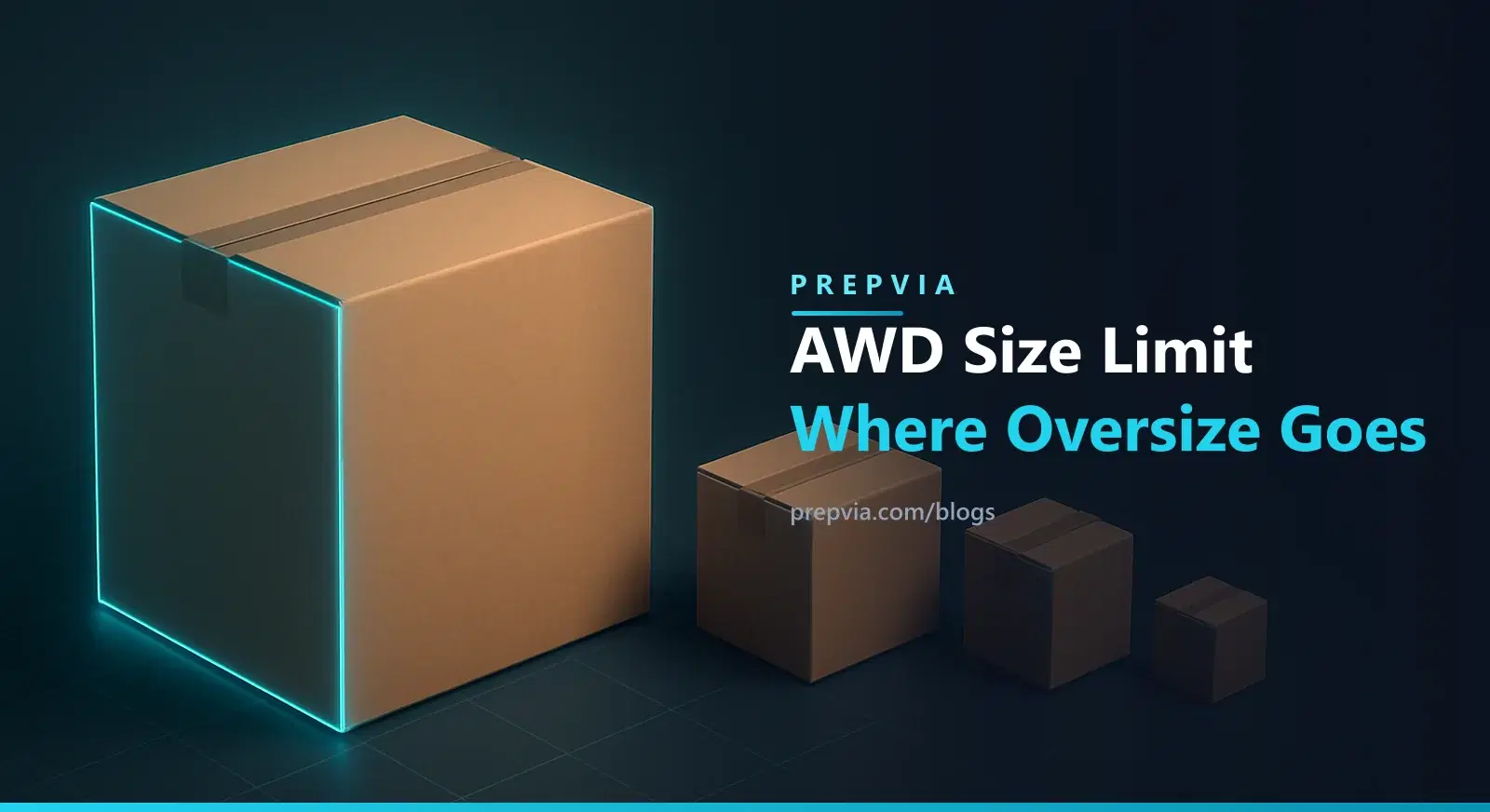
On July 31, 2026, Amazon Warehousing and Distribution stopped accepting new inbound shipments of bulky inventory in the United States. As of 2026 the cutoff is precise: AWD now accepts only sortable units smaller than 18 by 14 by 8 inches and under 20 pounds. If your sellable unit hits any one of those numbers, AWD is no longer part of your storage plan. Amazon has published no exception for any size tier or category, and no waiver path has been announced. Amazon points affected sellers at one alternative: send the goods directly into the FBA network through Send to Amazon.
That is a structural problem for a specific set of catalogs: furniture, fitness, outdoor, pet, and anything else that ships in a box you carry with two hands. Those are catalogs Amazon opened AWD to in August 2024, and bulky goods are the ones where cheap upstream storage matters most. The cubic feet are big, the demand is seasonal, and the FBA fee structure punishes both parking them at Amazon and running out.
This post is the operating answer: what the limit actually measures, what happens to stock already inside AWD, and the decision tree for where the pallets go now.
The 60-second version
The change: as of July 31, 2026, US AWD accepts only sortable units smaller than 18 by 14 by 8 inches and under 20 pounds. Anything at or above any single threshold is blocked from new AWD inbound shipments.
The detail everyone gets wrong: the limit is checked against the sellable unit, the single ASIN unit as it ships to a customer. It is not checked against the master carton. Repacking your export cartons changes nothing.
The grace period: bulky stock already inside AWD keeps replenishing FBA until it is depleted; freight still in transit at the deadline was handled per each seller's own notice. But once that pool drains, the ASIN cannot come back through AWD. Your buffer is now a wasting asset with a countdown on it.
The decision: oversize inventory now has three homes: FBA directly (where placement, peak, storage, and aged fees stack), your own warehouse (slow and heavy to stand up), or a 3PL or prep center acting as a bulk buffer that drip-feeds FBA. For most bulky catalogs the third option is the only one that survives contact with Q4.
What Changed on July 31, and the Exact Numbers
AWD was Amazon's upstream storage layer: low-cost bulk storage that automatically replenishes FBA, with placement fee advantages and no capacity-limit friction on the replenishment leg. For two years Amazon marketed it to exactly the sellers it just excluded.
The new eligibility test, as of 2026, has four checks. A unit must pass all of them to enter AWD in the US:
| Check | Threshold | Pass condition |
|---|---|---|
| Longest side | 18 inches | Must be under 18 in |
| Median side | 14 inches | Must be under 14 in |
| Shortest side | 8 inches | Must be under 8 in |
| Unit weight | 20 pounds | Must be under 20 lb |
Notice the wording. Amazon's notice and the AWD product eligibility help page now use the same rule: smaller than 18 by 14 by 8 inches and lighter than 20 pounds. The help page also spells out the other side of the line: an item with any dimension of 18 inches or larger, or weighing 20 pounds or more, is not eligible. A unit sitting exactly on a threshold is out. If your product measures 18.0 inches on its longest side, plan as if the door is closed and verify against your own listing in Send to Amazon rather than arguing the rounding.
Those dimensions are not arbitrary. They roughly track the boundary of what Amazon's own network classifies as sortable, the size range its automated facilities handle on conveyors. Everything above it needs floor space, forklifts, and people, and Amazon has decided its upstream warehouses are no longer in that business. The sortable network kept its discount storage layer; bulky goods lost theirs.
The Limit Applies to the Unit, Not the Master Carton
This is the most repeated point of confusion in the seller threads, so let me settle it.
The test is applied to the sellable unit: one ASIN unit, in its retail packaging, as it would ship to a customer. It is not applied to the master carton your factory packs six units into. A 24 by 20 by 16 master carton full of units that each measure 12 by 9 by 6 is fine. A trim 17 by 13 by 7 carton containing a single 25-pound kettlebell is not, and no amount of repacking will make it eligible, because the thing being measured is the kettlebell.
Two adjacent rules cause secondary confusion and are worth separating. First, AWD has always had its own carton and pallet requirements for how you box goods inbound, and those still exist independently. Passing the carton rules does not make an oversize unit eligible. Second, the FBA network itself is a different door with different limits: standard FBA inbound continues to accept large and bulky products, which is precisely why Amazon's guidance for affected ASINs is to ship them straight into FBA. The door that closed is the cheap upstream one, not the fulfillment network.
What Happens to Bulky Inventory Already Inside AWD
Amazon did not evict anyone. Per the seller notice, the transition works like this as of 2026:
Bulky inventory already stored in AWD stays there and continues to replenish FBA on demand until the stock is depleted. Shipments created before July 31 were reportedly still accepted even when they arrived in August or September, but confirm how your own freight was treated in your Seller Central notifications. Do not assume they were received. What you cannot do is send new bulky inbound. The pipe still drains in the normal direction; it just never refills.
Depletion is not a milestone to celebrate. It is the moment your bulky ASIN loses its automatic replenishment and joins every other seller's freight in the general FBA inbound queue, during the busiest receiving season of the year, with the Q4 arrival deadlines bearing down. If the buffer that replaces AWD is not live before the AWD pool runs dry, the gap between the two is a stockout, and the stockout lands in the quarter you can least afford one.
24 to 36h prep. 35-hour end-to-end guarantee or the prep is free. Net-30 terms. From 50 units to full truckloads.
The Decision Tree for Furniture, Fitness, Outdoor, and Pet
Oversize inventory needs to live somewhere between the factory and the FBA rack. With AWD out, there are exactly three candidates. Each one is the right answer for somebody, and each one fails a specific kind of seller badly.
Route 1: Push everything directly into FBA
This is Amazon's suggested path, and for a fast-turning bulky ASIN with stable demand it can genuinely work. The problem is the fee stack that lands on everything else. Bulky size tiers carry the highest per-unit rows on the inbound placement fee card. The holiday peak fulfillment fee window runs October 15, 2026 through January 14, 2027, as of the current fee schedule, and adds a per-unit increment on every order fulfilled inside it. Monthly storage steps up sharply for October through December, and bulky goods are, by definition, the cubic feet that fee is charged on. Units that do not clear by late December start walking toward the aged inventory surcharge, whose clock starts at 181 days in the network. And if you go thin to avoid all that, the low-inventory-level fee is waiting below 28 days of supply.
On top of the fees sits a ceiling: FBA capacity limits are set from your IPI score and Amazon's forecast of your sales, not your actual purchase orders, and oversize capacity is a separate bucket that bulky goods consume fast. Sellers who dumped their entire AWD position into FBA in August have already met this wall; the mechanics and workarounds are in the capacity limits overflow playbook. FBA-direct is a fine sales channel and a terrible warehouse; AWD just used to hide that for bulky goods.
Route 2: Run your own warehouse
Complete control, no per-unit storage math, and for a very large bulky catalog with steady year-round volume it eventually pencils. But be honest about the standing-up cost: a lease with a personal guarantee, racking rated for heavy product, a forklift and someone certified to drive it, a dock that can receive containers, insurance, and labor that shows up whether or not units are moving. The timeline from decision to first received container is measured in months, not weeks, which matters enormously when your AWD depletion dates are measured in weeks. We wrote the full cost breakdown in the hidden costs of running your own warehouse; the short version is that most brands reach the volume where this makes sense two or three years after they think they have.
Route 3: A 3PL or prep center as the bulk buffer, drip-feeding FBA
This is the structure that replaces what AWD actually did: hold the bulk cheaply outside Amazon, and release inventory into FBA in measured waves as demand consumes it. A pallet position at a 3PL is priced by the pallet and the month, or at PrepVia by the day, not by Amazon's Q4 storage multipliers. And the goods remain yours to redirect: to FBA, to a Walmart WFS shipment, to a wholesale order, to wherever the demand actually shows up. The trade-offs against AWD proper, and where each wins, are laid out in AWD vs 3PL in 2026. The difference since July 31 is that for bulky ASINs the comparison is over; only one of the two will take your freight.
| Route | Time to stand up | Relative holding cost | Amazon fee exposure | Flexibility | Best fit |
|---|---|---|---|---|---|
| FBA direct | Days | High in Q4, punitive if slow-turning | Placement, peak fulfillment, peak storage, aged surcharge, capacity limits | Low: sell it or remove it | Fast-turning bulky ASINs with short, predictable cover |
| Own warehouse | Months | Low per unit at scale, high fixed floor | None until inbound | Total | Large, steady, year-round bulky volume with capital to commit |
| 3PL / prep center buffer | Days to weeks | Moderate, priced per pallet per month | None until you release a wave | High: redirect any pallet any week | Seasonal or multi-channel bulky catalogs; anyone with AWD depletion dates inside Q4 |
The Drip-Feed Buffer, in Practice
Because the third route is where most displaced AWD sellers land, here is what it looks like when it is run properly rather than as a parking lot.
- Hold roughly 30 to 60 days of cover at FBA per bulky ASIN: enough to stay comfortably above the 28-day low-inventory-level fee threshold, not so much that December leftovers age into the surcharge.
- Hold the bulk on pallets at the 3PL, counted weekly, visible in software, ready to ship.
- Release replenishment waves against actual days of supply, not against a forecast made in August. When velocity spikes, waves go weekly. When it stalls, the pallets wait outside Amazon's meter.
This is the same mechanism AWD sold, rebuilt with a partner that accepts bulky freight. AWD could also route stock to Walmart WFS or wholesale through Multi-Channel Distribution; the difference now is that the pallet moves on your schedule rather than on Amazon's transfer cadence, and it can feed FBA today and a WFS or wholesale order next month.
The Q4 math is what makes this decisive right now. Peak monthly storage at Amazon runs October through December, priced per cubic foot, and bulky catalogs are cubic feet before they are anything else. Every pallet that waits at the buffer until it is actually needed is a pallet that skips the most expensive storage window of the year; the full comparison is in Q4 peak storage fees, FBA vs 3PL. The buffer also absorbs the capacity-limit problem: when Amazon trims your bulky capacity in November, the overflow has a floor to stand on instead of a container demurrage bill.
One caution from the receiving side of the dock: bulky freight is not a commodity service. A prep center that runs small-parcel arbitrage volume all day is not automatically equipped for 60-pound cartons, floor-loaded containers, or pallet-in pallet-out workflows. Ask specifically about heavy-unit handling, forklift capacity, and LTL experience before you route a container. We built PrepVia's operation in Miami, FL around exactly these catalogs; ask those questions in the first phone call.
- Audit the catalog this week. Flag every ASIN at or above 18 by 14 by 8 inches or 20 pounds on item package dimensions. That list is your migration scope.
- Date the AWD drawdown. Units on hand divided by weekly sell-through, per flagged ASIN. The earliest date is your real deadline.
- Pick the route per ASIN, not per catalog. Fast turners can go FBA-direct; seasonal and slow turners want the buffer. Mixed answers are normal.
- Stand up the buffer before the drawdown date. Receiving a container at a 3PL takes days to arrange; a warehouse lease takes months. Choose accordingly.
- Reroute inbound POs now. Anything on the water addressed to an AWD facility needs a new destination before it lands.
- Rebuild the replenishment cadence. AWD auto-replenishment is gone for these ASINs; someone, or some software, now owns the weekly days-of-supply check and the wave release.
- Check the Q4 calendar against all of it. Waves that need to sell during Black Friday still have to hit the inbound deadlines like everything else.
Frequently Asked Questions
What items does Amazon AWD no longer accept?
As of July 31, 2026, AWD in the United States only accepts sortable units smaller than 18 by 14 by 8 inches and under 20 pounds. Any sellable unit at or above one of those thresholds is blocked from new AWD inbound shipments. In practice that excludes most furniture, fitness equipment, outdoor gear, and large pet products, which Amazon now directs straight into the FBA network instead.
Does the AWD size limit apply to the master carton or the unit?
The limit applies to the individual sellable unit, meaning one ASIN unit in its retail packaging, not to the master carton it ships inside. Repacking oversize units into different cartons does not restore eligibility, because the unit itself is what gets measured. AWD keeps separate carton and pallet rules for inbound freight, but the July 2026 restriction is evaluated at the unit level.
What happens to bulky inventory already stored in AWD?
Nothing is being removed or forced out. Oversize stock that was already inside AWD continues to replenish FBA on demand until it is depleted. Handling of shipments still in transit on July 31, 2026 varied by seller notice, so check your own Seller Central notifications for how your freight was treated. Once that stock runs out, the ASIN cannot be replenished through AWD again, so the remaining pool is effectively a countdown to your migration deadline.
Where should oversize FBA inventory be stored now?
There are three realistic homes: directly in FBA, in your own warehouse, or at a 3PL or prep center that holds the bulk and drip-feeds FBA in waves. FBA-direct exposes slow-turning bulky goods to peak storage, aged inventory surcharges, and capacity limits, while an own warehouse takes months and real capital to stand up. For most seasonal or multi-channel bulky catalogs, the 3PL buffer reproduces what AWD did at a predictable pallet-per-month cost and keeps the inventory redirectable.
Final Take
Amazon built a discount storage layer, invited the bulky catalogs in, and then, on July 31, 2026, kept the layer and uninvited the catalogs. No appeal and no workaround have been published inside Amazon's walls: the replacement for AWD is not a setting, it is a physical building that is not Amazon's.
The sellers who get hurt by this will not be hurt on July 31. They will be hurt on the day their AWD pool quietly runs dry, in late October or November, with no buffer stood up and a capacity limit between them and their own inventory. The whole defense is a calendar entry and a phone call made early. Date the drawdown. Pick the building. Move before the countdown does.
Talk to PrepVia about oversize storage and FBA drip-feed →
Pallet-in, pallet-out bulk storage · 24-36h prep · Amazon SPN Certified · Miami, FL
Related Reading
- Amazon AWD vs 3PL in 2026: the full comparison, now settled for bulky goods
- FBA Capacity Limits: The Overflow Playbook: what to do when Amazon caps your inbound
- Q4 Peak Storage Fees: FBA vs 3PL: the cubic-foot math for October through December
- Amazon Q4 2026 Inventory Deadlines: the backward calendar your waves must hit