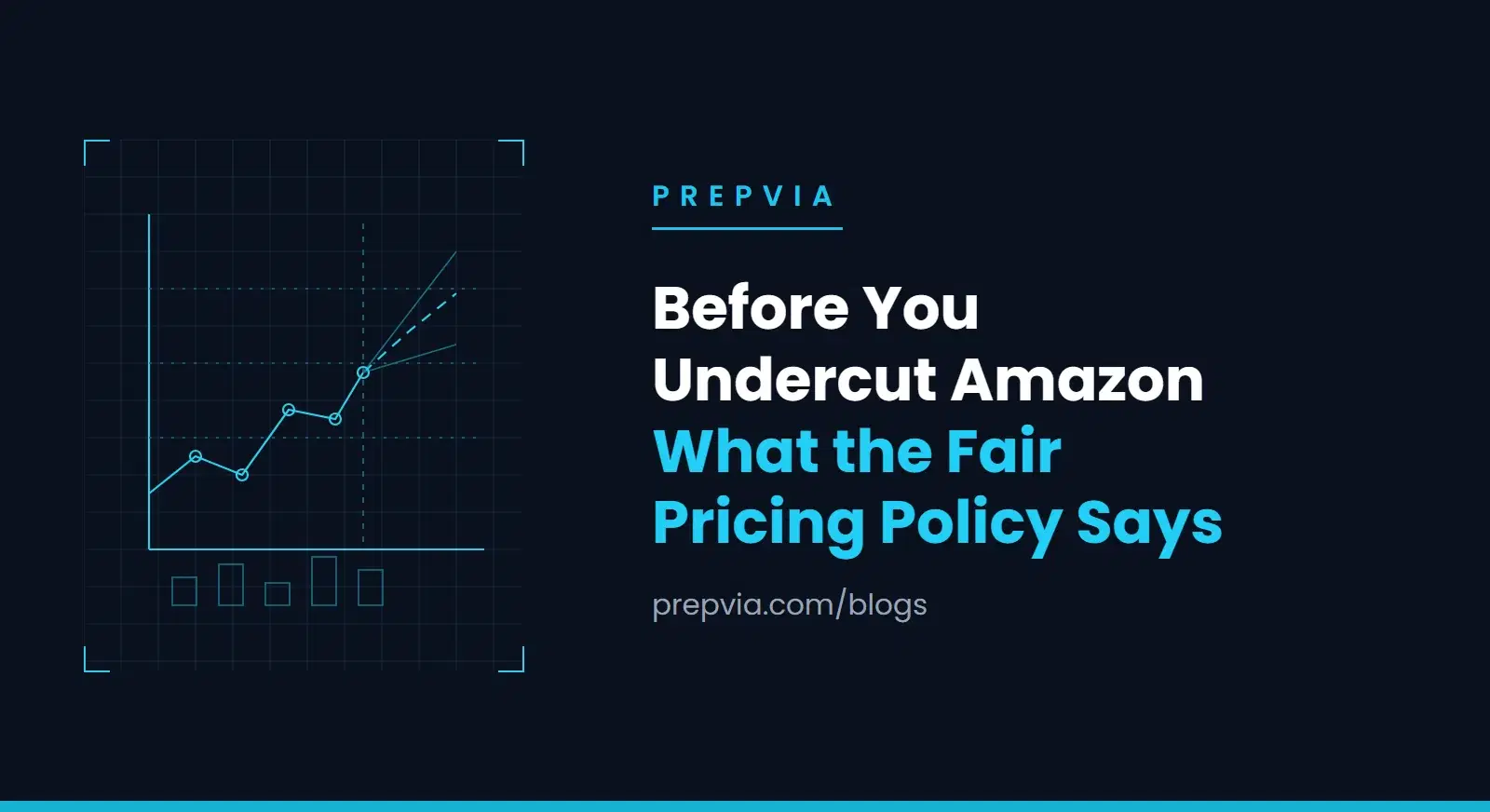
Before You Undercut Amazon on Walmart or TikTok Shop: What Amazon's Fair Pricing Policy Says About Your Off-Amazon Price
Amazon compares your price with other retailers, even per unit, and can remove the Featured Offer. Read its Fair Pricing Policy before you undercut on Walmart.

By Bernardo Campelo, Forbes Business Council E-Commerce Leader, Amazon SPN Certified provider, Amazon SP-API authorized partner, and Founder of PrepVia.
As of October 29, 2026, Amazon's Marketplace Fair Pricing Policy says Amazon monitors the prices in its stores, including shipping costs, and compares them with other prices available to customers. One of the practices it lists as harmful is a price significantly higher than recent prices offered on or off Amazon. One of the actions it can take is removing the Featured Offer, which Amazon's Becoming the Featured Offer page describes as the offer with the Add to Cart and Buy Now buttons on a product detail page.
That matters the week a brand opens a second channel. A launch price on Walmart or a promotion on TikTok Shop is a price off Amazon. Amazon's Pricing Health page names the number your offer is measured against, the competitive external price, and says an offer priced above it can be ineligible to become the Featured Offer. Amazon does not say which retailers it checks.
The comparison also runs the other way: Walmart's pricing rules and TikTok Shop's listing rules both react to an item priced far above what it sells for elsewhere. Below: what each marketplace publishes and the pricing plan to settle before the holidays.
The 60-second version
Amazon compares your total price, item plus shipping, with prices outside Amazon, and an offer priced above the competitive external price can be ineligible for the Featured Offer. Amazon defines that number as the lowest price plus shipping for an equivalent item recently found at another reputable retailer, and it can work per unit: its own example turns a six-pack sold elsewhere into the threshold for a 12-pack. In the US, the separate seller eligibility gate is gone as of September 2026, but Amazon says it is not changing how the Featured Offer is selected. Walmart and TikTok Shop publish their own rules against pricing far above other sites.
Every rule, date and name below was checked on October 29, 2026 against Amazon's Seller Central help pages and Seller Forums announcements, the Selling Partner API documentation, Walmart Marketplace Learn and TikTok Shop's US Seller University, linked where they first appear. Marketplaces edit these pages without notice, so open the live page before you set a holiday price.
What Amazon's Fair Pricing Policy Says
The policy starts with responsibility: "Sellers are responsible for setting their own prices on Amazon stores." When Amazon sees pricing practices that harm customer trust, it can remove the Featured Offer, remove the offer, suspend the ship option, or, in serious or repeated cases, suspend or terminate selling privileges. It names four practices and says the list is not complete:
- A misleading reference price. Setting a reference price on a product or service that misleads customers.
- A price above recent prices. Setting a price significantly higher than recent prices offered on or off Amazon.
- A multipack priced above the single unit. Selling multiple units of a product for more per unit than a single unit of the same product.
- An excessive shipping fee. Amazon considers current public carrier rates, reasonable handling charges and buyer perception when it judges a shipping price.
"On or off Amazon" means the comparison is not limited to other sellers on your listing. And the policy gives no percentage for "significantly higher," so a plan built on staying a few points under an imagined threshold is built on a guess. The policy reaches bundles too: Amazon's product bundling policy says bundles must comply with it.
The Competitive External Price: The Number Behind Featured Offer Eligibility
Pricing Health is where Featured Offer eligibility on price becomes a number; the Fair Pricing Policy itself sets none. It lists offers that are ineligible to become the Featured Offer for one of two price reasons: they aren't priced competitively against retailers outside Amazon, which Amazon calls the competitive external price, or they are priced significantly higher than recent prices on Amazon or elsewhere. Its FAQ puts the first case plainly: the offer is ineligible when "your total price (selling price plus shipping) is above the competitive external price, when one is available."
Amazon defines the competitive price threshold, the same number under a second name, as "the lowest price plus shipping for an item or items that customers may consider to be equivalent, recently found at another reputable retailer outside the Amazon store." Three parts of that definition matter to a brand on more than one channel:
- Where Amazon looks. It may use both online and physical store prices, and for online retailers it may leave shipping out when customers could get the item without paying for shipping, such as from a retailer with a large store presence or consistent free shipping.
- Who it checks. Amazon does not reveal the names of the retailers it checks. Nothing on the page names Walmart, TikTok Shop or any other store.
- What counts as the same item. The threshold can come from products customers may consider equivalent because they have near-identical attributes, such as size, design, material and features, even under a different or generic brand name.
Amazon's own pack-size example is the one to keep in mind. It may use the per-unit price of a six-pack of hand sanitizer found at another retailer to set the threshold for a 12-pack of the same product on Amazon, multiplying the outside per-unit price by 12. The comparison can follow the unit, not the box.
The second test uses reference prices, for offers priced higher than recent prices. Amazon's suggestion for each case is direct: set the total price at or below the competitive external price, or align it with the reference prices. Pricing Health lists the reference prices it can use:
| Reference price | How Amazon describes it |
|---|---|
| Featured Offer price | The price of the current Featured Offer. |
| 60-day average selling price | What customers paid in the Amazon store over 60 days, weighted by units sold, excluding promotions such as Best Deals and Lightning Deals but including sale prices. |
| Highest 14-day price | The highest price in the past 14 days for the product shipped and sold by Amazon. |
| List price | The suggested retail price from a manufacturer, supplier or seller; in the US, the MSRP is a list price. |
| Per-unit derived price | The per-unit Featured Offer price of a smaller bundle of the same product, multiplied by the units in your listing. |
| Typical price | The 90-day median price buyers paid on Amazon. |
| 60-day average offer price | The mean weekly offer price, averaged over 60 days. |
What Changed at Amazon in 2026, and What Did Not
On July 6, 2026, Amazon announced in the Seller Forums that it would begin removing seller eligibility requirements for the Featured Offer. In the US store, that step is done. The Becoming the Featured Offer page says: "As of September 2026, Amazon no longer maintains a seller eligibility requirement, and offers from all sellers are now eligible to be evaluated for the Featured Offer."
The selection itself did not change. The July announcement said so in one line: "We're not changing how the Featured Offer is selected." Amazon says it keeps evaluating offers on the criteria that matter most to customers, with price, delivery speed and performance as its examples. Removing the gate let more offers into the ranking; it did not lower the bar on price.
The same help page explains why price matters even on a listing with one seller. Individual offers may still not be selected if they are not competitive, and Amazon will not feature any offer if none meets its customer experience requirements, even when the product has only one available offer. That is how a brand selling its own product can lose the Featured Offer with no competing offer on the page: the comparison can come from a price outside Amazon.
Reference prices tightened during the year as well. Since April 23, 2026, Amazon validates a List Price only if the product was recently offered at that price at another retailer, or customers bought it as the Featured Offer on Amazon at that price, according to its reference pricing announcement. Amazon's policy on reference prices makes you responsible for keeping the reference prices you provide current.
A Bigger Pack Does Not Take an Offer Out of the Comparison
The tempting answer to a price conflict is a different configuration on each channel: singles on one marketplace, a multipack on another. On price, Amazon's own pages close most of that gap.
- The comparison works per unit. The six-pack example sets a 12-pack threshold by the unit, and the per-unit derived price, a reference price, does the same with a smaller pack on Amazon.
- The policy caps the multipack. The Fair Pricing Policy names selling multiple units for more per unit than a single unit of the same product.
- Only the brand creates the pack. Amazon's ASIN creation policy says a new ASIN must be a product configuration created by the brand owner or manufacturer, and that sellers should not list non-standard multipacks the brand owner or manufacturer did not create. An Amazon moderator wrote in the Seller Forums that this policy "has already prohibited creation of non-standard pack sizes since 2024."
- Equivalent counts, not just identical. Because the threshold can come from near-identical products under another brand name, a cosmetic change may not reset the comparison.
Bundles of different products sit under a separate policy with its own date. Amazon announced on September 10, 2026 that, effective January 11, 2027, most product bundles listed as a single ASIN must be packaged by the original manufacturer or brand. The exceptions are bundles repackaged with a letter of authorization from the brand owner or manufacturer, bundles in gifting browse nodes and camera product types, and Virtual Bundles that brand owners and authorized resellers create in Amazon's tool. Our exit plan for bundles you assembled yourself covers what to decide before that date, and our seller calendar for 2027 and the kitting versus bundling guide cover the rule itself.
Price follows bundles too. Amazon's virtual product bundles page says a virtual bundle priced higher than the sum of its components' current prices, active deals included, "will lose Featured Offer eligibility," and that it "must cost at least 1% less than buying the components separately" to appear in the "Bundles with this item" widget. An Amazon moderator added on October 28, 2026 that placement in that slot is not guaranteed.
None of this makes a multipack or a bundle a bad product. It makes it a product decision for the brand that owns the items, not a way to keep two prices apart.
"Before you list on a second marketplace, decide what is really different about that offer. A bigger pack is not, because Amazon can compare the price per unit. If it is the same product, plan for both marketplaces to compare your two prices."
Bernardo Campelo, Founder of PrepVia
Walmart and TikTok Shop Compare Prices Too
Walmart's Pricing Rule automatically unpublishes offers priced egregiously higher than prices currently or recently offered for the same item on Walmart.com or a competing website, or at a level that could be viewed as price gouging. Walmart reviews the listing price and the shipping fee, and affected items carry the reason code Reasonable Price Not Satisfied. Below that level, in certain cases where an offer is priced substantially higher than prices on Walmart.com or competing sites, Walmart removes the Add to Cart button and the offer's price and shipping from the item page; customers can still buy through More Seller Options.
Walmart's FAQ answers "No" to the question of exceptions, and its guide says failing to follow the pricing rules may result in account suspension or termination. It watches the low side too: offers priced too low can be unpublished with the reason code Pricing Error. When an item complies again, Walmart republishes it automatically, typically within 48 hours. A seller can also submit or correct an external price match, which Walmart validates within 48 hours.
TikTok Shop's US product listing guidance says not to set prices "significantly higher than recent prices on or off TikTok Shop," which may be treated as deceptive pricing, and not to charge more per unit for multiple units than for a single unit. Its Fair Pricing Policy prohibits prices much higher than comparable products on the market, says listings priced significantly lower than comparable products may be reviewed as potentially suspicious, and counts frequent price changes that prevent a stable selling price as misleading. Enforcement can include Account Health Rating deductions and listing removal. In campaigns, TikTok Shop's Campaign Price Transparency guide lists the lowest price for a similar product found on other websites or apps among the rules that can cap a campaign price.
| Marketplace | What the rule compares | What happens to a price above it |
|---|---|---|
| Amazon | Total price against the competitive external price (other reputable retailers, not named) and against reference prices | The offer can be ineligible for the Featured Offer. Separately, the Fair Pricing Policy allows suspension of selling privileges in serious or repeated cases of the practices it names |
| Walmart Marketplace | Listing price and shipping fee against Walmart.com and competing websites | Add to Cart removed, or the offer unpublished as Reasonable Price Not Satisfied |
| TikTok Shop (US) | Recent prices on or off TikTok Shop, and comparable products on the market | May be treated as deceptive pricing; Account Health Rating deductions and listing removal are possible |
The practical point: undercut Amazon on Walmart and, if Amazon finds that price, the Amazon offer can lose Featured Offer eligibility; price Walmart far above what the item sells for on other sites and Walmart's rule can react instead. Either way, the gap between your two prices is the thing to manage.
How to See It Before It Costs You
- Pricing Health. It lists offers ineligible for the Featured Offer on price, offers within 5% of the Featured Offer price, and offers deactivated for potential pricing errors, which Amazon detects based on several factors, including its Fair Pricing policy and the price limits you set. You can download up to 50,000 Featured Offer pricing opportunities and update prices in bulk through the List Your Products tool.
- A dispute for a stale threshold. If you believe the competitive external price behind a disqualification has changed, Pricing Health describes a self-service dispute through Get help and resources or Seller Assistant: select the Featured Offer workflow, provide the ASIN and SKU, and confirm you are disputing a changed external price. Amazon says resolution can be automated in as little as 30 minutes.
- Seller Assistant. Since August 4, 2026, Amazon says Seller Assistant can explain why an offer isn't the Featured Offer, covering pricing gaps, delivery speed gaps, regional coverage gaps and buyability issues, for up to 10 ASINs in one conversation.
- The SP-API. For teams that reprice in software, the ANY_OFFER_CHANGED notification is sent when the external price, the price from other retailers, changes for an item you sell, and its CompetitivePriceThreshold element carries the threshold. The PRICING_HEALTH notification is sent when an offer is ineligible to be the Featured Offer because of an uncompetitive price.
- Walmart's side. The Unpublished Items dashboard shows a reference price for each unpublished item. The Item Report shows Buy Box eligibility, and the Pricing Insights dashboard counts an offer as competitive when it is listed at or below the comparable external price.
A Pricing Plan Before the Second Channel
The work happens before the second listing goes live, and it uses the same inputs the rules use: total price, per unit, per channel. Each step is a decision for the brand's pricing and marketplace teams, made product by product.
- Map one price per channel. For each product, write down the total price a customer pays on each channel, item plus shipping, divided by the units in the pack. Put Amazon's reference prices from Pricing Health next to those numbers.
- Decide the floor you can hold everywhere. If it is the same product, the lowest price you post on any channel is a price Amazon may measure your Amazon offer against. Set that floor with Amazon's fees and the other channel's fees in the same spreadsheet.
- Put promotions on one calendar. A promotion off Amazon is a lower outside price while it runs. Decide before it starts: run the same price on Amazon for the same dates, or accept that the Amazon offer may lose Featured Offer eligibility until the outside price changes. When the promotion ends, check Pricing Health and dispute the threshold if it has not caught up. If you matched the promotion with an Amazon sale price, check the reference prices there too: the 60-day average selling price includes sale prices. Amazon extended its US deadline to submit Black Friday and Cyber Monday deals to November 13, 2026, which gives the Amazon side of a holiday calendar a date to plan against.
- Make product differences real. If a channel needs a different offer, make it a product the brand owns: a pack or a kit the brand creates, priced so no unit costs more than the single unit, and, for bundles with other brands' products, the authorization the January 11, 2027 rule requires. Do not create a near-identical variant to separate two prices; Amazon's definition of an equivalent item can already cover it.
- Keep your own policies yours. If your brand runs a minimum advertised price policy, it is your own document: none of the Amazon, Walmart or TikTok Shop pages cited here mention one. How to write or enforce it is a question for your lawyer.
For a product sold on two channels, that leaves three options: the same total price everywhere; a promotion off Amazon with the Featured Offer risk accepted for its duration; or a different product the brand owns. A bigger pack of the same item is not one, because it can still be compared per unit. Each has a cost, and each is a decision to make before launch, not after the Featured Offer disappears in the middle of the holiday season.
Where a Prep Center Fits
A prep center does not set prices, decide what a marketplace will accept, or create listings. The seller registers the listing and owns the catalog; pricing, compliance and legal questions stay with the brand and its counsel.
What a prep center does is build and ship the physical product the brand decides on. When the channel plan calls for a multipack or a kit, that configuration has to exist as a packed, barcoded unit before it can be sold. At PrepVia:
- Kitting. Kits, bundles and multi-packs, built to the configuration the brand decides on.
- Barcodes. PrepVia applies the bundle barcode and verifies it by scan; the seller registers the listing.
- Channels. Prep for Amazon FBA, Walmart WFS and TikTok Shop. Our Walmart and TikTok Shop API integrations are in the researching stage. Listings and prices stay in your own seller accounts either way.
- Receiving. Discrepancies are reported within 24 hours of arrival, with photos.
Before a multichannel launch, ask any prep partner which configurations it can build and at what volume, how it labels for each channel, and how it reports a count that does not match the packing list. The answers decide whether the product you priced is the product that arrives.
Frequently Asked Questions
What does Amazon's Fair Pricing Policy prohibit?
Pricing practices that harm customer trust, including a misleading reference price, a price significantly higher than recent prices offered on or off Amazon, a multipack priced higher per unit than the single unit, and an excessive shipping fee. Amazon can remove the Featured Offer or the offer and, in serious or repeated cases, suspend or terminate selling privileges.
What is the competitive external price?
Amazon also calls it the competitive price threshold: the lowest price plus shipping for an item or items customers may consider equivalent, recently found at another reputable retailer outside Amazon. Amazon does not reveal which retailers it checks.
Can a lower price on Walmart or TikTok Shop cost me the Featured Offer on Amazon?
It can if Amazon finds that price. Pricing Health says an offer is ineligible to become the Featured Offer when its total price is above the competitive external price, when one is available. Since Amazon does not name the retailers it checks, plan as if it can see your other channels.
Does a multipack or a bundle avoid the price comparison?
Not on price. Amazon may set the threshold for a larger pack from the per-unit price of a smaller pack sold elsewhere, its policy bars charging more per unit in a multipack, and bundles must comply with the fair pricing policy. From January 11, 2027, most bundles must also be packaged by the original manufacturer or brand.
Did Amazon change how the Featured Offer is selected in 2026?
No. It removed the separate seller eligibility requirement, which in the US store is gone as of September 2026, and said "We're not changing how the Featured Offer is selected." Offers that are not competitive may still not be featured, and total price, item plus shipping, plays an important role.
Do Walmart and TikTok Shop have similar rules?
Yes. Walmart can remove the Add to Cart button or unpublish an offer priced far above prices on Walmart.com or competing websites, and TikTok Shop's US rules prohibit prices significantly higher than recent prices on or off TikTok Shop.
Final Take
Amazon's Fair Pricing Policy is short, and the Featured Offer selection did not change in 2026. What a brand opening a second channel needs to absorb is how concrete the comparison is: a named number in Pricing Health, built from prices outside Amazon and, across pack sizes, adjusted per unit. Walmart and TikTok Shop publish their own versions.
So settle the price plan before the second listing goes live: one map of total price per unit across channels, one promotion calendar, and product differences that are real. The rules will compare your prices either way. The plan decides whether that comparison costs you the Featured Offer in the middle of the holiday season.
See how PrepVia builds kits, bundles and multipacks →
PrepVia is Amazon SPN Certified, prep window 24-36 hours, Net-30 available.
Stop managing prep. Start shipping.
We prep in 24 to 36 hours and guarantee 35 hours end to end, or the prep is free. No minimums, up to full truckloads, and you pay Net-30.