Types of Logistics: How PrepVia Can Help You Streamline Operations
Logistics is the backbone of every successful e-commerce operation. Yet many sellers treat it as an afterthought, focusing on marketing and product development while neglecting the infrastructure that moves goods from point A to point B. Understanding the different types of logistics is the first step toward building a supply chain that scales. In this guide, we break down each type and show how PrepVia helps sellers master every stage.
What Are the Types of Logistics?
At its core, logistics refers to the planning, execution, and management of how goods are acquired, stored, and transported. The types of logistics can be broadly categorized into five areas: inbound logistics, outbound logistics, reverse logistics, third-party logistics (3PL), and warehouse logistics. Each plays a distinct role in the supply chain, and understanding these types of logistics helps sellers identify where inefficiencies hide and where improvements deliver the highest return.
Inbound Logistics
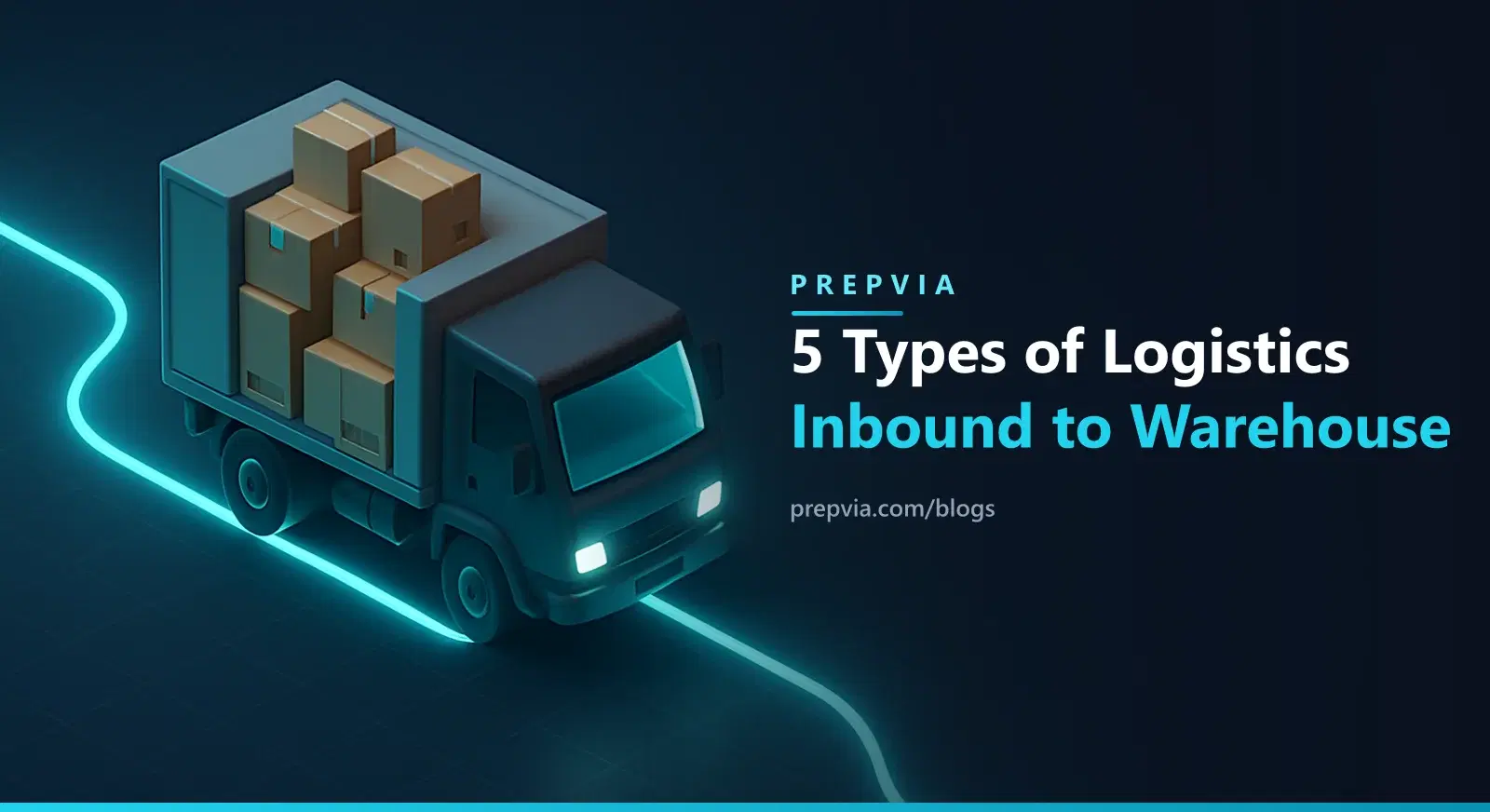
Inbound logistics covers everything from sourcing raw materials or finished goods to receiving them at a warehouse. For Amazon sellers, this means managing supplier relationships, freight forwarding, customs clearance, and intake inspections. Poor inbound logistics leads to delayed inventory, damaged goods, and lost selling days. PrepVia streamlines inbound logistics by offering intake inspection with photographic evidence, variance checks, and real-time notifications so sellers always know the status of incoming shipments.
Outbound Logistics
Outbound logistics is the process of getting products from your warehouse to the end customer or to Amazon fulfillment centers. This includes picking, packing, labeling, palletization, and carrier coordination. Outbound logistics directly impacts delivery speed and customer satisfaction. Among the different types of logistics, outbound is where most sellers experience bottlenecks. PrepVia's automated systems process thousands of units in 24 to 36 hours, ensuring outbound logistics never becomes a growth constraint. Our infrastructure handles FNSKU labeling, poly-bagging, bundling, kitting, and outbound freight coordination, with Amazon Freight FTL on final shipments of 1 to 26 pallets.
Reverse Logistics
Reverse logistics deals with the flow of goods back from the customer to the seller or warehouse. Returns, refunds, exchanges, and product recalls all fall under reverse logistics. For Amazon sellers, return rates can range from 5 to 15 percent depending on the category, making reverse logistics a significant cost center. Effective reverse logistics requires inspection, restocking, and sometimes repackaging of returned units. PrepVia supports sellers with return processing workflows that inspect, sort, and restock eligible units quickly, minimizing the financial impact of returns.
24 to 36h prep. 35-hour end-to-end guarantee or the prep is free. Net-30 terms. From 50 units to full truckloads.
Third-Party Logistics (3PL)
Third-party logistics, commonly known as 3PL, involves outsourcing logistics operations to a specialized provider. A 3PL partner handles warehousing, prep, fulfillment, and shipping on behalf of the seller. For growing e-commerce businesses, 3PL is one of the most important types of logistics to understand. Working with a 3PL like PrepVia eliminates the need for sellers to invest in warehouse space, hire staff, or purchase equipment. Instead, sellers plug into an existing infrastructure built for speed and scale. PrepVia operates as a full-service 3PL with proprietary automation, real-time tracking, and Amazon-compliant prep processes.
Warehouse Logistics
Warehouse logistics focuses on the internal operations of a distribution center or warehouse. This includes inventory management, storage optimization, order fulfillment workflows, and the types of warehouse in logistics setups that maximize throughput. The types of warehouse in logistics vary from traditional storage facilities to modern automated fulfillment centers. PrepVia's warehouse is designed for high-velocity e-commerce, with racking systems, automated prep stations, and digital inventory management powered by our proprietary PrepVia App.
How PrepVia Connects All Types of Logistics
Most sellers struggle because they treat each logistics function in isolation. PrepVia unifies inbound, outbound, reverse, 3PL, and warehouse logistics into a single streamlined operation. From the moment inventory arrives at our facility to the moment it reaches Amazon's fulfillment centers, every step is tracked, automated, and optimized. Understanding the types of logistics is not just academic. it is the foundation of a profitable, scalable business. Whether you send 50 units or 40,000 units in a single shipment, PrepVia has the systems to handle it.
Related PrepVia Services
- Amazon 3PL Services. Full-service third-party logistics for Amazon sellers
- Amazon Prep Service. FBA prep, labeling, and compliance packaging
- FBA Labeling Service. High-speed FNSKU labeling at 13,200 units/hour